

When the Evercade first launched, for a good while its carefully curated cartridge compilations featured mostly familiar titles from big name, old school publishers.
The likes of Namco, Atari and Data East all had multiple collections, allowing players to revisit classic titles and even discover games they may not have played before, despite their vintage nature.
Yet as the Evercade’s library grew, so too did the scope of its releases. Even among the ‘classic’ compilations, the odd unreleased title could be found – making it the only legal way ever to have experienced certain games.
‘New Retro’ games began making an appearance too, most notably with the Xeno Crisis/Tanglewood cartridge, which was followed by a bigger compilation, the Indie Heroes Collection 1 cartridge.
Several more collections featuring modern games designed for retro hardware have followed, each finding a natural home on the Evercade.

There hadn’t been a cartridge featuring less than two games, however – with the aforementioned Xeno Crisis/Tanglewood and Alwa’s Awakening/Cathedral being the only cartridges to have just two games on, apiece.
Until now, that is.
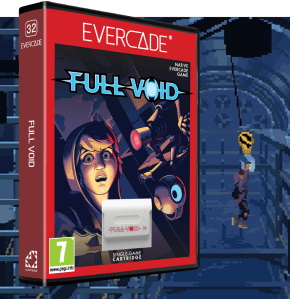
Full Void is the first Evercade cartridge to feature just one game; the question is – given that so many Evercade cartridges feature carefully curated compilations of games – is it worth the asking price for a single game?
The answer is slightly complicated.
First things first – and without spoiling the purpose of a review entirely – Full Void is an absolutely fantastic game.
A puzzle platformer with stunning animation that recalls 90s Delphine classics such as Another World or Flashback, albeit with more modern puzzle design sensibilities, Full Void is also running natively on the Evercade – which means no save states or multiple save slots.
That’s right, to progress in Full Void, you’ve got to do it the old fashioned way. How very retro.
Technical details aside, what is Full Void about?
In Full Void, you’re cast in the role of a teenager – in a future where humanity has been enslaved by a rogue AI.
Scared and alone, your story starts with you merely trying to survive against the robots roaming the bleak, lonely post apocalyptic city.

Yet your quest for safety soon takes you much closer to the AI and its various minions than you may have initially expected.
Full Void is incredibly atmospheric, with a minimalist approach to sound design that makes for maximum impact when things get really intense.
Which happens quite a bit over Full Void’s three hours or so of playtime.
Jump scares, terrifying chases that you’ll escape by the skin of your teeth – when Full Void kicks off, it does incredibly well to keep you invested and clinging on the edge of your seat.
The story is told through wordless cutscenes; including the death animations, which you’ll see a lot of.
There’s a huge amount of environmental puzzles in Full Void and, though puzzles are always a bit hit or miss for me, I found them to be logical and solvable in a way that my autistic brain could cope with; it made me feel extremely clever, all the way through the game.
Some of the puzzles also require programming of objects, which were among my favourite brain teasers in the game.
There’s the occasional puzzle or platforming challenge that has a ridiculously tight time limit; though these can frustrate and take quite a few attempts to overcome, note that I’m writing this review having completed Full Void, so each of these are possible, as much as they may annoy you in the moment.

Along with this, another frustrating element is the sometimes inconsistently placed checkpoints, which can sometimes force you to overcome particularly difficult sections numerous times, which can be incredibly annoying.
And yet, despite these issues, Full Void manages to get its metallic claws in you deeply – and it doesn’t let go until the credits roll.
The experience you have throughout does get cathartic as the end sequence plays out and the credits roll, but it goes to some very sad, bleak places beforehand.
In fact, it’s impressive just how involving and compelling the story is, considering that it’s told entirely without dialogue.
So, the question remains: is Full Void worth the price of entry, given that it’s part of a library of cartridges featuring multiple games?
Full Void is a fantastic game, of that there’s no doubt. At just three hours long though, with no other titles on the cartridge, it doesn’t feel like great value for the Evercade – its single icon on the Evercade’s menu just doesn’t feel quite right, given the console’s nature.
That’s not to say that Full Void isn’t worth the price; perhaps it’s a more natural fit for the numerous other platforms it’s been released on, however.
A great game with a short runtime, then – whether or not you can justify the price, in order to ensure there’s no gaps in your Evercade collection, is something I’ll leave up to you, dear reader.
You can purchase the Full Void cartridge from Amazon here.




 MLGG: Pop Culture News, Reviews & Interviews
Leave a comment