

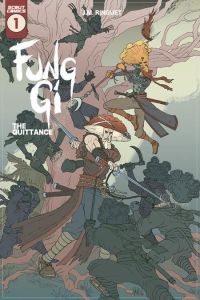
While passing through the tree city of Hild, a caged Captain pleads with a wandering swordsman and his companion to free her in exchange for a reward.
Though initially trying to avoid involvement in the plight of Uril Barius, the captured Captain, the honourable, yet outcast, swordsman – Basan Natta – is unable to ignore her pleas for long, setting in motion a thrilling rescue.
How did Barius end up captured by slavers in the first place, though? Who was responsible – and why?
This first chapter of the Fung Gi saga introduces readers to an unusual setting and a great cast of characters; the planet that the story takes place on is one populated by sentient, bipedal mushrooms and giant insects, the society mirroring that of feudal, lightly fantastical Japan.
Warring clans, honour bound ronin and skilled mystics populate the world, which creator JM Ringuet builds with a great deal of detail in both art and lore.
It’s a fascinating place and its rendered beautifully, with many lovely touches to its illustrations that really bring the world to life, right from the first panel.
Presented with one of the elements of fantasy fiction that truly gets me invested immediately – a world map – I felt ready to settle into the world of Fung Gi immediately.
Each character is also nicely distinct; not just in terms of their looks – making them easy to distinguish from one another as soon as we meet them – but also their personalities too.
A great deal of intrigue is set up in this first issue, mostly around the mystery of what led to the capture of Uril Barius, but the post-story passages of lore for her and Basan Natta hint that there’s much more to be explored in future chapters.
Bringing to mind the anthropomorphic animals in Stan Sakai’s excellent Usagi Yojimbo stories, Fung Gi sets itself apart with a more naturalistic style and colour scheme, though sharing the same straight-faced treatment of historical culture that Sakai’s series has, despite the potentially comedic visuals.
Though violent, Fung Gi gets away with its graphic dismemberment through its usage of fungal characters in lieu of squishier, blood-filled sentients. It’s another clever touch that makes the story more palatable; it certainly avoids offending the more delicate sensibilities that some readers may have about violence.
Fung Gi #1 is an excellent read; it’s got a unique, compelling setting and style, setting up plenty of story threads to be explored further down the line.
You can buy Fung Gi #1 directly from Scout Comics, in either physical or digital form here – with a choice of multiple covers too.
Many thanks to JM Ringuet for providing me with a digital copy of Fung Gi #1 for review purposes.



 MLGG: Pop Culture News, Reviews & Interviews
Leave a comment