


Note: Nearly two decades ago, I used to write reviews for a now defunct, independent UK board game retailer, Infinity Games.
I’d been approached by the owner of the site after he read one of my reviews on Board Game Geek; he thought it was cool and asked if I wanted to write for him, in exchange for store credit.
Getting to write and working my way to discounted or even free games felt like a dream come true at the time, so I jumped at the chance.
So here’s one of the reviews I wrote for the site, in its entirety, warts and all (albeit with a few formatting edits to make it a bit easier to read!).
It’s a fascinating look at my technique and tastes at the time and, obviously, I feel like my writing has improved immeasurably even though for most of the years between then and now, I didn’t write at all.
Another note to bear in mind: I was required to give marks out of ten, with decimal points, for a number of game aspects at the end of the review.
I always prefer for my text to speak for itself and was never comfortable with this, but I’ve retained them here to ensure it reflects the original article.
Enjoy!
My 2005 Battleground: Fantasy Warfare Review

Battleground: Fantasy Warfare is a miniatures wargame with a difference.
A big difference.
Instead of buying scores of expensive miniatures along with paints and other materials with which to prepare your armies, you simply invest in the decks of cards that you need – each Starter deck contains enough ‘units’ (which are represented by cards rather than miniatures) to create two 1500-point armies of the same faction along with a command card deck, basic rules and reference cards.
This is enough for two people to play (therefore a very minimal investment is required to actually get started with the game), but for a more interesting game each player should have at least a different Starter deck each.
There are currently three factions available – Men of Hawkshold, Orc Army and Undead Army – with each one represented by a Starter deck and a Reinforcement deck.
Reinforcement decks contain fifty unit cards and an advanced rule book.
The only extra materials that are required are six-sided dice (and lots of them!), as well as the previously mentioned dry erase markers.
It’s very easy to get started with Battleground – the basic rules contained with each Starter deck also contain quick start rules which can be learned in minutes, and these handily teach the basic mechanics of the game in order to get you started.
Once these become familiar, it is then much easier to move on to and learn the basic rules.
Advanced rules contain rules for playing scenarios, multiplayer (ie more than 2 players), terrain and more. This means that the game can be played with whatever level of complexity the players choose – which is a very welcome feature.
Players first take turns to build their armies to a point total that they both agree on – 1500 points is used for a standard game. Each unit has a point cost, and players are free to create any single faction army that they want as long as they do not exceed the agreed point total.
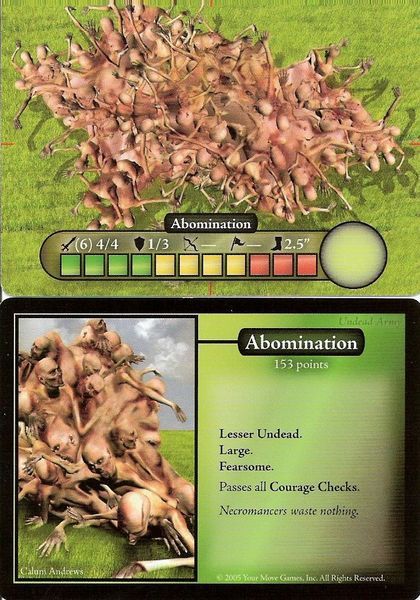
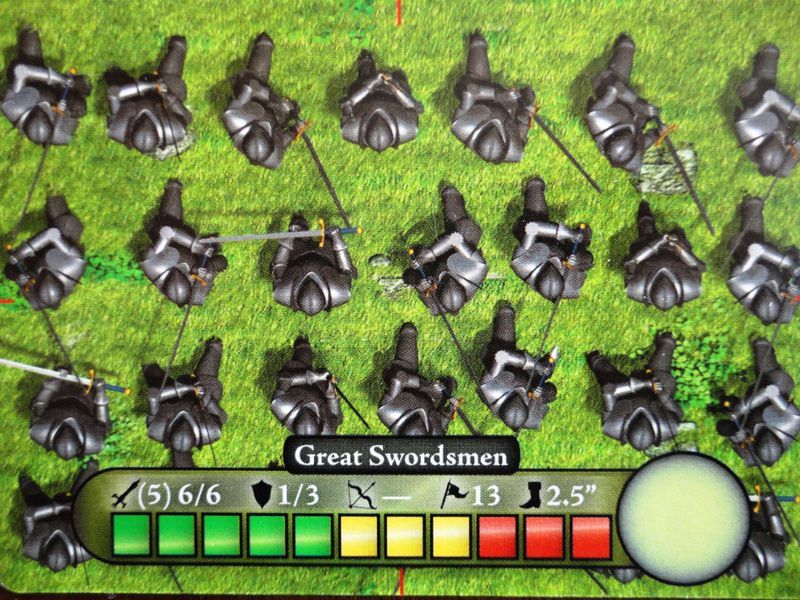
Unit cards, when face up, show a bird’s eye view of the relevant units as well as a damage bar and all necessary details such as power, defence, courage, speed and so on. The other side of the unit cards details important information about bonuses and penalties to attack rolls or defence, as well as the card’s point cost.
Command cards can also be purchased (up to 150 points worth) at 25 points each. These cards are drawn during the next phase – deployment.
Units are then deployed and standing orders are issued. These are written in the command circle on the card – it is advisable to use a dry erase marker as these commands do change, and dry erase marker wipes off very easily.
Also, place each card in a protective sleeve – even though it would be ok to write directly on the cards, they will eventually wear out.
Placing them in sleeves not only protects them from this, but also from general wear and tear during play.
Dry erase markers write on and wipe off just as easily on the sleeves as on the card itself. You can find the correct sized sleeves here – make sure to specify clear sleeves, as important information is also on the rear of the cards and is needed during play.
Once commands are issued, players then take turns to move their units one by one according to their standing orders. During this phase – Movement & Command – players can use command actions, which offer many extra options, some faction-exclusive (for example, the Undead Army can use the ‘reanimate’ action to give health back to their units).
Players have one command action for every five hundred points used during army construction – so in a 1500-point game, players will have three command actions available to use during this phase.
When units meet or move within range of an enemy unit, combat ensues during the combat phase. Combat is pretty simple and involves a few quick dice rolls, although working out bonuses and penalties can take a little getting used to.
Damage is marked off on the cards – each unit has a damage bar to keep track of how many hits they have taken.
When the damage bar is full, the unit is destroyed. Rout checks must sometimes be made, and these can sometimes result in a unit being destroyed as they disband in terror – but more often than not this causes the unit to run away from battle!
In a basic scenario, when a player destroys all of his opponents units, he wins the game.
Despite its appearance, Battleground is not a ‘light’ wargame – that is to say, it is as complex and involving as a full miniatures-based game. While it is easy to learn the basics, it is still a far more complex game than a German-style game or an average board game, in keeping with its wargame-style tactical depth.
It is definitely a lot quicker to play than the average wargame too (unless of course you play with 5,000-point armies!), which is great for those of us with time constraints.
It’s very satisfying to build an army and watch your plans unfold on the battlefield, and there are many different options available every turn.
As with the most involving games, there are always too few actions and too many options, causing agonizing decisions every turn about how best to organise movement and attack of each unit.
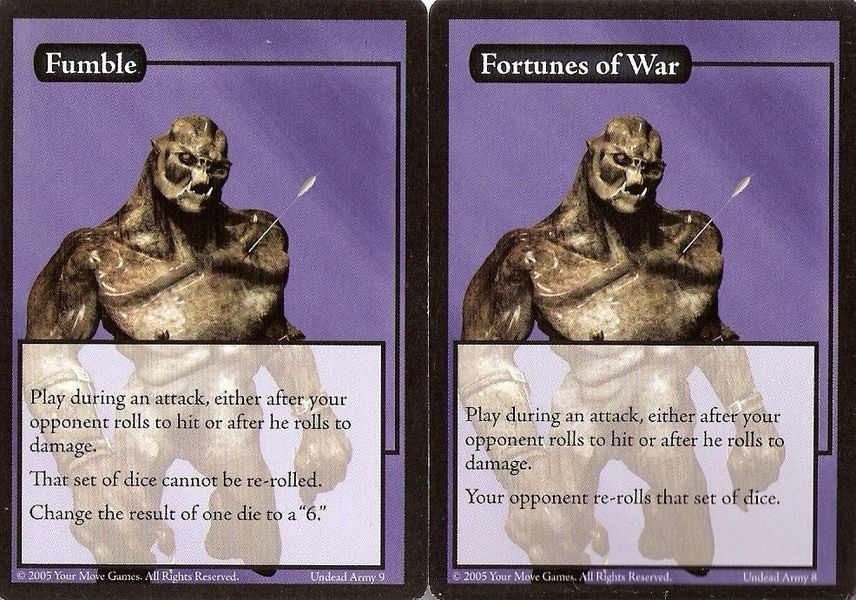
The command card and command point systems are very well implemented, and combat is very clean and easy to resolve.
All movement in the game is measured in card lengths (various multiples of short and long lengths of the card sides), which makes measuring distances very simple indeed.
There are a few minor negative points that I should raise though. The rulebook is tiny, and it is reasonably difficult to locate clarifications of rules when you most need them.
Some of the rules are also a little unclear or badly explained, such as the explanation of reducing movement categories when taking direct control of units.

Also, the reference cards that are included with the starter decks do include all of the information you need when changing a unit’s movement or applying modifiers to combat situations, but it is hard, especially for the first few games, to remember what all of the terms mean.
Even after the first few games, it is still tough to remember everything that you need to know as there are so many situations where these modifiers will apply. There is also a rather glaring omission from the reference cards that would have assisted greatly in learning the game – a turn summary.
These minor points don’t detract from the enjoyment that can be gleaned from Battleground though.
It could have ended up being incredibly gimmicky – the unique selling point, after all, is the fact that it is a cheap wargame played with cards instead of miniatures – but the designers have not taken the easy way out.

It’s an absolutely superb recreation of the classic miniatures style wargaming experience, made much more affordable and both easy to set up and take down again.
As the decks fit in standard playing-card sized boxes, it’s also much easier to find space for than boxes of miniatures.
Battleground is a highly compelling and endlessly replayable game, perfect for players without the time or inclination to paint and assemble miniatures as well as spend huge amounts of money in order to afford an army of them.
It’s an easy game to learn, but players looking for more complexity are free to use any advanced rules as they see fit – it’s a brilliantly scalable system.
Battleground deserves to be a huge hit – it’s easily one of the best games that I have played for a long time, and comes highly recommended for all players looking to scratch that wargame itch in a convenient and affordable format.
Summary
Presentation
Basically just decks of cards – cardstock is average, but the cards are well illustrated. The various modifiers and damage trackers are well laid out and do not obscure the view of the units. 7.5/10
Clarity of Rules
The rules are printed on a tiny and surprisingly thick book, and could definitely have been presented in a more easy to read manner. There is quite a bit to keep track of, and some useful information – such as turn summaries – appears only in the book, not on the reference cards. 7.0/10
Game Length
Games typically last around 1 1/2 hours but this can depend on the scenario played. The length of the game is adaptable to suit the needs of the players. 8.8/10
Value
Superb – you’d have a hard time buying a single army in a normal miniatures game for the price of all six Battleground decks. 9.5/10
Overall
An excellent concept, brilliantly implemented. A very affordable miniatures-style game without any of the hassle or expense. 9.2/10 (not an average)

 MLGG: Pop Culture News, Reviews & Interviews

Leave a comment