
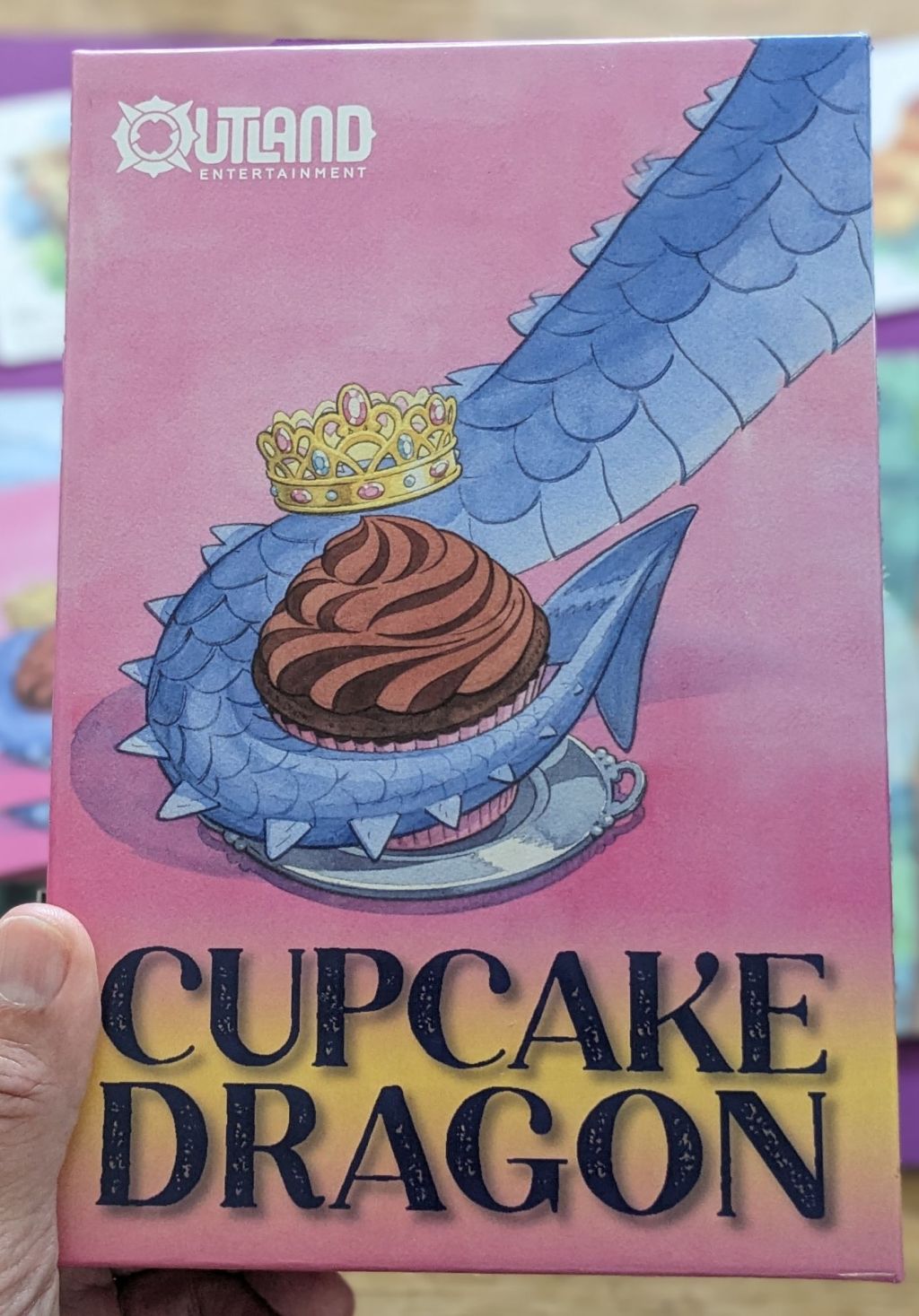
Accompanying a children’s book of the same name, Cupcake Dragon is a family board game that’s due to be published later in 2024. I was fortunate enough to be given a prototype of the game to offer my thoughts on (thanks to Outland Entertainment!); both the game and book will be looking to crowdfund via Kickstarter too (you can sign up to be notified of the campaign launch here).
In Cupcake Dragon, players are mayors of different villages, looking to entice the titular mythical creatures to their settlement for protection. The best way to attract a dragon to your village is to offer it delicious cupcakes and shiny piles of loot. So, at the end of three game rounds, the player with the most loot in their stash will lure the dragon to their village and win the game!
A very easy game to pick up and play for gamers of just about any age, in Cupcake Dragon, there’s a very Uno-esque flow to the gameplay, which will see you playing a card to the discard pile that matches the Suit of the previous card played.
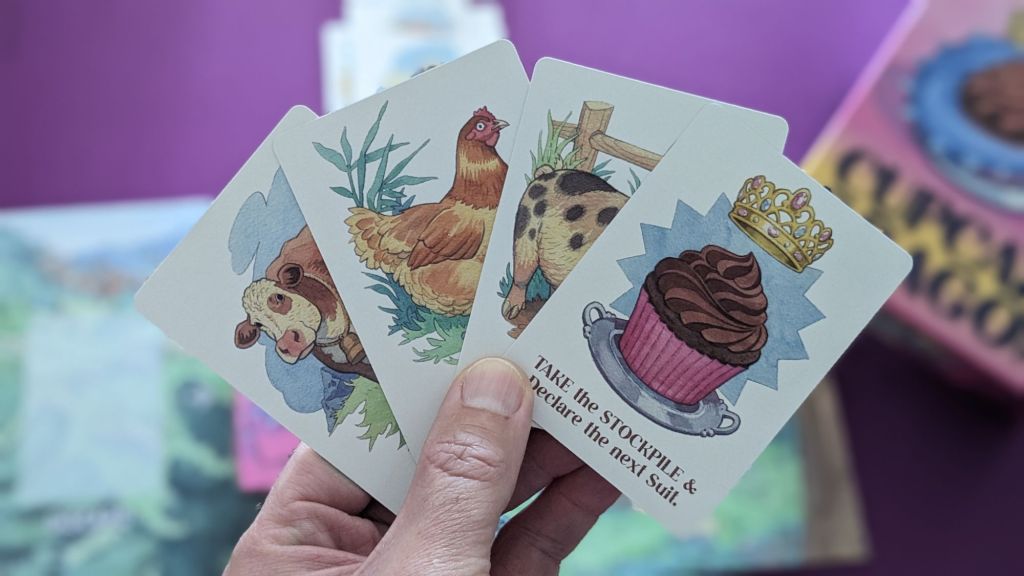
Suits come in the form of different animals: chickens, cows, sheep and pigs. Some of these cards have text with different effects, such as Reverse (which, in a fairly self-explanatory way, reverses the order of play), taking Loot from the Bank, or even giving loot to, perhaps taking it from, another player. Swap cards can change the Suit, but there are also, of course, cupcake cards; these are wild and allow the player who used them to not only take the stockpile of Hoard tokens, but also change the Suit to one of their choice.
When the Hoard tokens from the space on the playing board are depleted, the round ends and the dragon goes to the player with the most loot; though this is the ultimate aim of the game, prior to the game ending this doesn’t give the benefit you may expect. Having the dragon visiting you requires payment of a cupcake card from your hand (unless you don’t have one, in which case you must give the dragon a randomly chosen card from your hand), and also reduces your hand limit from 5 cards to 4.
It’s a very fast paced game that’s easy to pick up and play, though there are a few wrinkles in the rules that could do with a bit of clarification. Note that the version I played is far from final and is actually a prototype, so any issues highlighted here will likely not be a problem when the game is released.
For example, there’s a rule that you must pay tokens to the Bank if you can’t match the current Suit, then play any card onto the discard pile. Though this isn’t difficult to grasp as a rule, the question as to whether or not the action on the card is carried out is one that’s not clarified in the rules themselves.
The rules also don’t do a great job of explaining or making it clear why there are multiple dragon cards. The reason for this is in case of ties (in which case the tied players each get a dragon), but this does need a bit of emphasis, as the rules wording often refers to the dragon, when there’s actually three of them!

Another issue with the rules is the lack of clarity on why you’re penalised for attracting the dragon before the end of the game. Of course, it seems to me that this is to ensure that the winner of the rounds, prior to the last one, has a bit of a handicap so they don’t run away with the victory immediately, but this could definitely be explained so as to not confuse players.
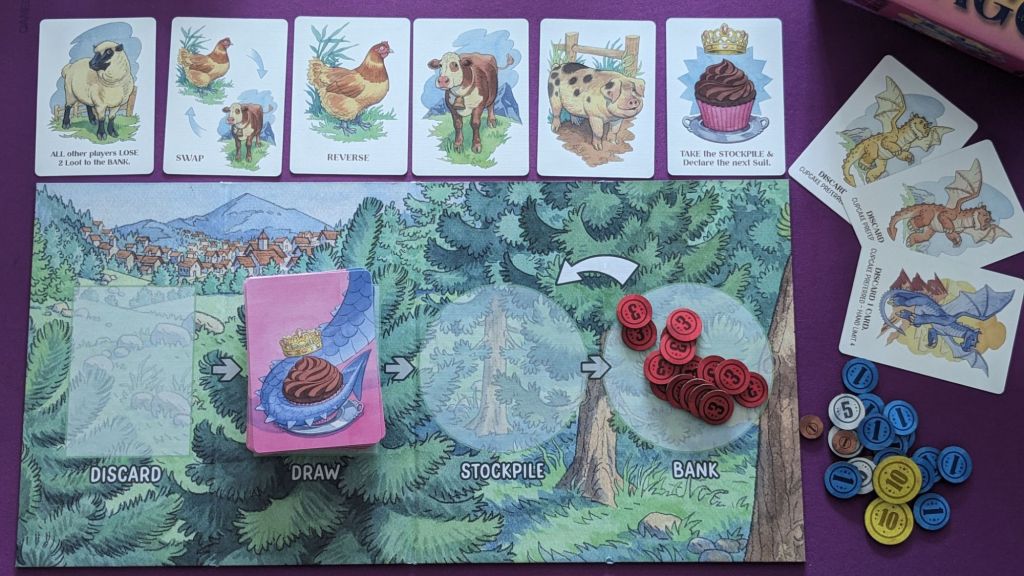
The prototype version also has an error on the board, which shows the word ‘Bank’ instead of ‘Hoard’, but this is definitely something I wouldn’t expect to be in the final version at all.
It’s a really nicely designed game from a visual standpoint, with some absolutely gorgeous artwork. The board is incredibly helpful, with arrows that perfectly illustrate the flow of the game. I really appreciated that aspect of the game, particularly when learning and introducing Cupcake Dragon to new players.
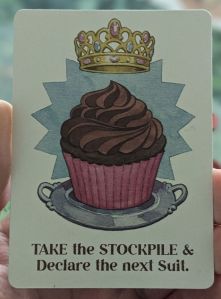
One thing that became apparent during multiple playthroughs and with different numbers of players involved is that, quite often, the winner would simply be the person who ended up drawing the most cupcakes.
This was especially apparent in two player games, where having a cupcake card seemed almost too powerful; my thoughts on this is that the number of cupcakes in the deck should probably be limited or reduced depending on the number of players taking part in the game, which would help to balance it out somewhat.
Though a variant is included to ensure that even the youngest players can take part, in which card action text can be ignored, it does make the game too simple, though again if the idea is to involve players who have yet to be able to read, that’s an admirable aim to at least get them playing a game that goes beyond the simple roll and move fare they’re likely to be used to.
Players looking for a deeper or more strategic game will likely not find much of interest in Cupcake Dragon, but that’s hardly the point of the game, with it excelling as a straightforward experience that’s designed so that the whole family can take part.
The theme may feel slightly thin in terms of how it’s applied alongside the game mechanics, but Cupcake Dragon has adorable visual design, well thought out components and accessible gameplay that can serve as the introduction to slightly more involving games for even the least experienced of players.
Cupcake Dragon the game and book will be seeking crowdfunding via Kickstarter very shortly; you can register your interest and be notified of the campaign’s launch by signing up here. Many thanks to Outland Entertainment, for providing me with the Cupcake Dragon prototype for review purposes.

 MLGG: Pop Culture News, Reviews & Interviews
Leave a comment