
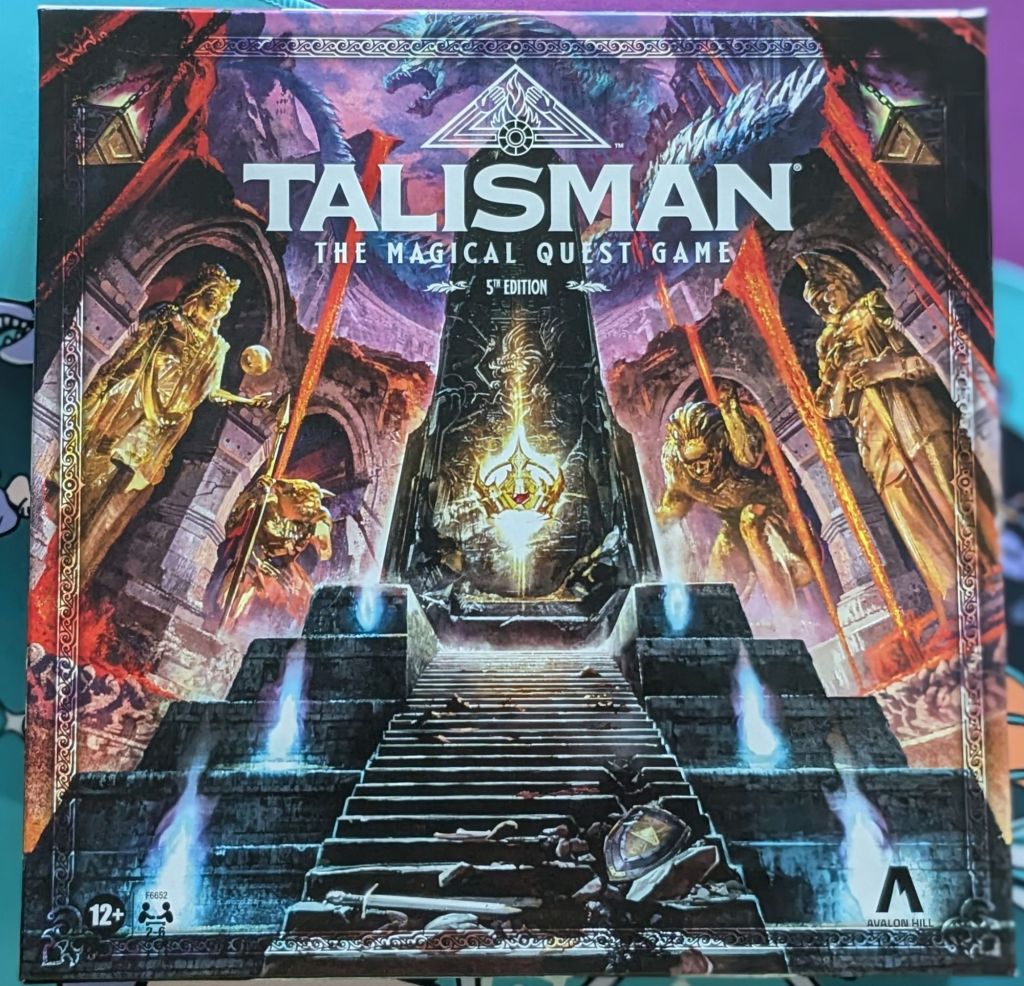

Given that 2023 marked the 40th anniversary of the original Talisman’s release, it was disappointing that a new edition wasn’t released to mark the occasion. However, discovering that a new edition was on the way just a few months ago, and the fact that it was released so soon after it was announced, was an incredibly welcome surprise.
For the uninitiated, Talisman is a board game in which players take control of an archetypal fantasy character (Warrior, Wizard, or even Troll, for example) and set out to take control of the Crown of Command, having random encounters and dealing with the environment on different squares along the way.
It’s a really straightforward game to play, and it’s fair to say that it’s not particularly deep; yet it’s always been a game that, thanks to its simplicity, can be picked up and played by gamers of just about any age or experience level, and they’ll always end up with a fun, if somewhat random experience each time they play.
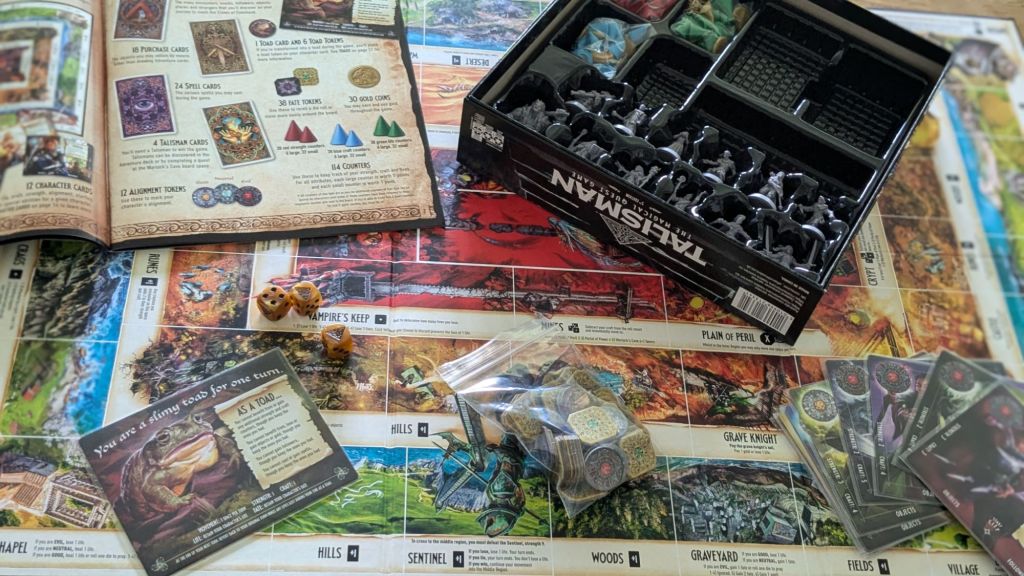
Previous editions of Talisman have sought to streamline and refine the game in numerous, incremental ways, without touching the core experience. 5th Edition does the same, albeit in an ever-so-slightly more radical ways, with a few amendments that speed the game up and even deal with what could be a torturously drawn out endgame.
So, Talisman then. Players choose a character (this is new, believe it or not; previously, characters were dealt out to players randomly), from a generous selection of 12. Another new aspect is that, even though characters have an alignment (Good, Neutral or Evil) printed on their cards, it’s now permitted to choose your alignment at setup if you want.
Each character has their own special ability or abilities, along with their own Life points total, Fate points, Gold coins, Strength and Craft, the latter two stats of which are used in physical or psychic encounters, either against creatures, specific encounter card events or the environmental challenges on the board itself.
Players have a starting space that they place their gorgeous miniature in, and they may have starting equipment or spells that they can also gather before play begins.
During each turn, players roll a six sided die and move the amount of spaces it shows; there’s always a choice of at least two directions to travel in, with three distinct regions of the board: the outer region is where they begin and is likely where they’ll spend most of their time, then there’s the more challenging middle region and, finally, the inner region, which is where the endgame begins for each player (and where you’ll move a space at a time, rather than roll to move).

The final space is in the centre and it’s here that one of the biggest changes to the game is found; in the standard version of Talisman, this space would usually see players using the Crown of Command to try and inflict a point of damage on each other player per turn, winning the game when they were the last player standing. Now, however, players get to the space and take on a powerful dragon, winning the game if they can beat it in a single round of combat.
This speeds up the climax massively, though some players may feel that it’s a little anti-climactic and may just see the game devolving in its latter stages to a race for being the first person brave enough to venture into the inner region, rather than giving other players a chance to catch up.
In any case, on a normal turn players move to a space and ‘encounter’ it; usually this means drawing from the encounter deck, but sometimes die roll must be made on the space itself, or it may be possible to buy and sell items or heal, for example.
Encountering a creature means engaging them in combat; you’ll typically (this can change with some equipment cards or character abilities) roll a six sided die, then add the number to your Strength or Craft (depending on which stat the creature has), then roll a six sided die for the creature and add that total to their single stat. If your total is higher, you win and can take the creature as a trophy; if it’s a draw, it’s a stand off and the creature stays on the space to be encountered when landed on again, and if the creature total is higher, the player takes one Life point of damage and the creature stays on the board.

Losing all of your Life points means you die, and this used to be pretty devastating in earlier editions of the game, setting players back massively if it happened. However, in 5th Edition it’s much more forgiving, and is more akin to being knocked out rather than dying; you simply relocate to the Tavern space, and if you have enough Gold, you can pay 1 Gold to restore a point of Life up to your starting total, but if you have none you simply give yourself 1 Life. This is a great new approach to ensure that death, or being knocked out, is a setback but one which it feels as if you can still recover from, without the game being drawn out any further.
Trading in creature trophies to increase your Strength or Craft is now much easier and quicker, and you can do so once you’ve accumulated trophies that meet or exceed your current Strength or Craft total; if you have 3 Strength and trophies totalling 3 or more Strength, for example, you can trade them for an extra point of Strength.
Moving around the board, dealing with monsters and spaces as you seek to build up your Strength and Craft is what you’ll be doing for most of the game, and for the most part it’s fun and engaging enough, with some serious chaos and randomness in the drawing of encounter cards, that it’s actually pretty fun for the most part. You can take on other players in combat if you’re brave enough too, stealing their equipment or coins if you win.
That fun can sometimes be subject to the luck you have with card draw and dice rolls though; as encounter cards feature creatures of varying difficulties alongside overly punishing events and randomly acquired equipment, you may find yourself against some impossible odds early on which can still slow down the refined, slightly retooled mechanics.
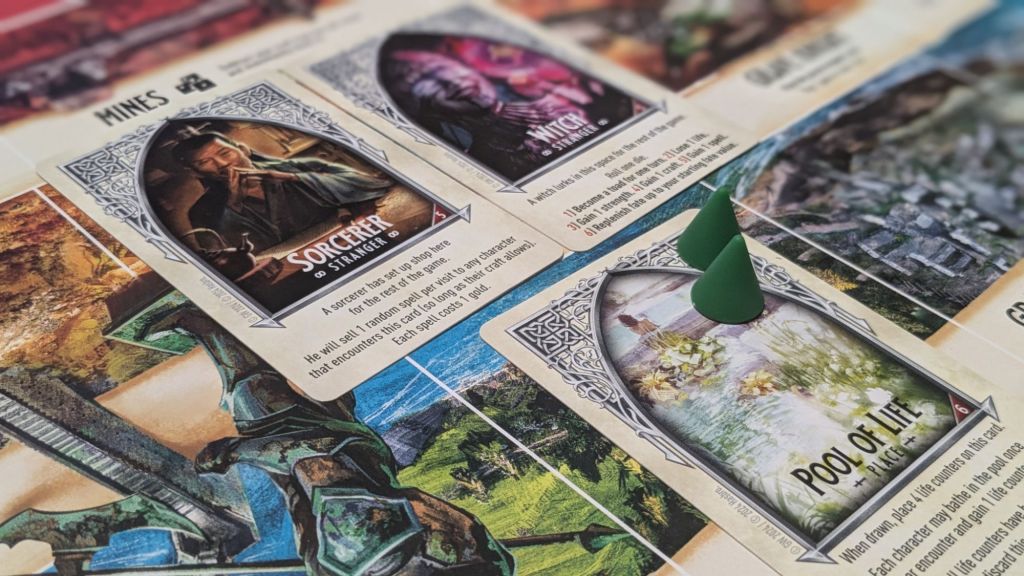
Yet that’s all part of the fun, which long term players of Talisman know well. If you have been turned off by the reliance on luck that permeates so many elements of Talisman in previous editions, the refinements may not go far enough to change your mind.
It is a faster game to play than prior editions of Talisman, but if you want to play it the old way, with the old rules, you can still do so. Which is cool.
Something else that’s great about the new Talisman is its production values and thoroughly modern graphic design; it’s a beautiful, well produced game with some genuinely lovely components. I’m not quite sure about the cone-style point Strength/Craft/Life tracker tokens, especially as the two sizes of them just aren’t different enough for them to be obviously representing 1 point or 5 points each; I much preferred the dials on the player boards in Talisman: Star Wars, which also did a great job of speeding up the core Talisman experience without losing the essence of what made it so appealing in the first place.
A minor bugbear is that the decks of cards aren’t a standard size, and I’m a stickler for sleeving cards to protect them; having them in an odd size makes sleeving them more problematic than it should be, and there’s also the issue that the cards themselves are the one component in Talisman: 5th Edition that feel a little underwhelming, quality wise.
The dice aren’t premium or anything, but they’re a lovely, sort-of marbled and glittering gold colour; the one issue I have with them is the Talisman symbol being the 6, when I’m so used to that being the 1. It also makes sense that it’d be the 1, considering it’s a single symbol!
Still, those are real nitpicks; as the first new edition of Talisman for 17 years (!), it’s definitely great to see an old favourite back and with at least some concessions to modern game design. The last edition of Talisman, Revised 4th Edition, was supported by a huge and impressive range of expansions, and the first one has already been announced for 5th Edition; intriguingly, it’s an entirely new one and isn’t just rehashing old material.
So it looks like Talisman: 5th Edition has a bright future ahead of it, and I’m personally very pleased that it continues to endure and find new generations of players. Despite a core design that can feel somewhat antiquated at times, this is the most modern Talisman has felt in some time, without the chaotic, RPG-lite gameplay being altered too much. In some ways it’s a shame that Avalon Hill were a bit too conservative with updating it, but it’s a good way of retaining fans of the original while attracting new players.
Many thanks to Hasbro for providing me with a copy of Talisman: 5th Edition for review purposes.
 MLGG: Pop Culture News, Reviews & Interviews
Leave a comment