

Ratalaika continue their work in re-releasing classic games with Aero the Acro-Bat, a platform title originally launched in 1993 on the 16-bit SNES and Mega Drive (or Genesis if you’re in the US).
At that time, it seemed like every video game publisher had an anthropomorphic animal mascot in a platformer, usually with ‘attitude’. That’s all thanks to the enormous success of Sonic the Hedgehog, Sega’s own mascot, who emerged to tons of hype in 1991 and quickly became a video game icon.
There really were an incredible number of platformers with anthropomorphic animal protagonists back then; so many are long forgotten and, frankly, best left in the past.
Aero the Acro-Bat was publisher Sunsoft’s attempt at carving themselves a slice of that sweet hedgehog pie, starring a character with a surprisingly unusual moveset, in a circus setting.
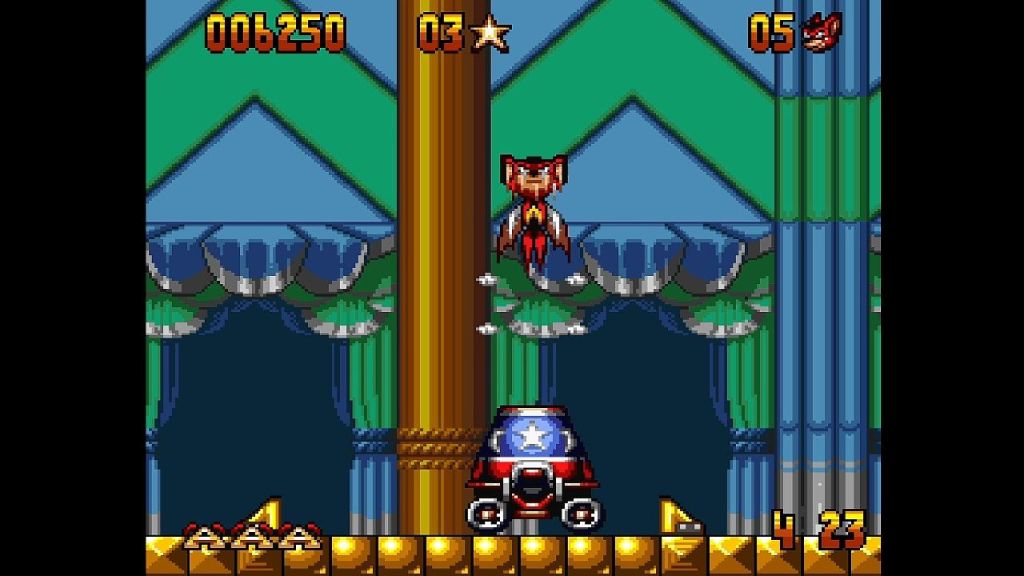
The biggest strength of Aero the Acro-Bat as a game is that its levels have really varied objectives; on some stages, for example, you might just be trying to find specific platforms to destroy, whereas others will see you hunting for a key and rescuing another animal from captivity, but there’s other types of objective too.
It all looks very nice, in terms of its colourful pixel art and lovely animation. Though there’s a time limit on each stage, you can carry on working towards your objective if it ends; it just means you won’t get a bonus. This is very welcome, because there’s numerous, glaring issues with Aero the Acro-Bat that have seen it age really poorly.
While titles from the early 90s weren’t always easy, generally the game design of the time had moved on from the ultra-challenging, often unfair levels of difficulty that you’d see in, for example, Atari or NES games from just a few years earlier. Sunsoft didn’t get the memo, it seems, because Aero the Acro-Bat is punishingly difficult, and often in a way that feels cheap and completely unfair.
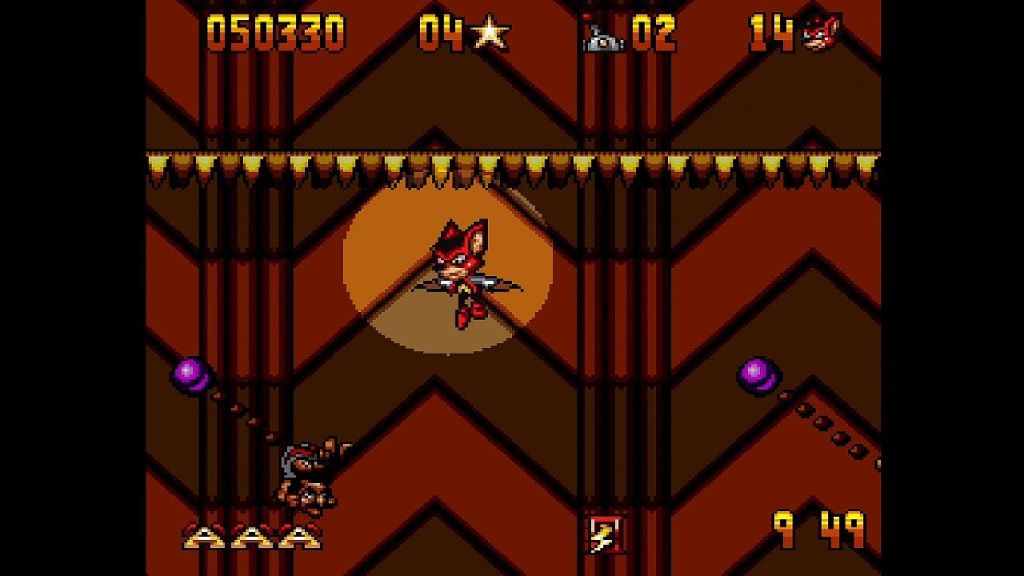
Though Aero himself can build up a decent bit of speed if you’re able to move him consistently in a single direction for long enough, that is something you’ll often be punished for, with enemies and obstacles feeling like they’re coming out of nowhere, placed in sections of the level which make them impossible to see until they’re right on top of you and, by that time, unavoidable.
Though it’s great that objectives are varied, the levels themselves are torturously labyrinthine with no map or pointers to your objective, so you can end up going down lethal sections of a stage for absolutely no reason, and then have to backtrack through precariously placed obstacles again.
Aero’s drill move seems fairly unresponsive and inconsistent, but it’s required to dispatch most enemies and to traverse the levels, with lots of very precise positioning needed, and platforms placed in unforgiving arrangements.
Enemies themselves even seem inconsistent in how you get rid of them too, sometimes necessitating being hit from a certain angle to kill them. Oh, and spikes, which seem to be placed everywhere (and, I really must stress, often in unpredictable spots offscreen) will rob you of your whole health bar, and a single life, upon one touch, whereas most enemies remove just one section of your health.

The environments, however, are full of neat ways to get around; cannons, unicycles on tightropes and trampolines, for example; it’s just that the levels are so restrictively designed that you rarely get to use them in a satisfying way.
Though this version of the game, released on contemporary platforms by Ratalaika, features save states and rewind (and a gallery featuring the game’s manual, which you’ll definitely want to read!), it’s still incredibly frustrating in terms of its difficulty level; while I was never one to shy away from games with extremely challenging games back in the day, there’s a difference between tough and outright unfair, and Aero the Acro-Bat swings far too much toward the latter. If you’re really determined to see your way through the game, there is a cheat function, but it generally just highlights even more how convoluted, unfair and badly designed the game is.
If you were a fan of Aero the Acro-Bat back in the 90s, you’ll likely enjoy revisiting it on your current console. It’s an odd beast though, and hasn’t aged well at all; if you didn’t play it on its original release, or if you weren’t a fan back then, having save states and rewind won’t convince you to enjoy it. Aero the Acro-Bat was succeeded by a better sequel and spin-offs, but this was an awkward start for the series and one which is probably best left in the rose-tinted glow of nostalgia.
Aero the Acro-Bat is out now for PS4/5, Xbox One/Series and Nintendo Switch. Many thanks to the publisher for providing me with a code for review purposes.




 MLGG: Pop Culture News, Reviews & Interviews
Leave a comment