
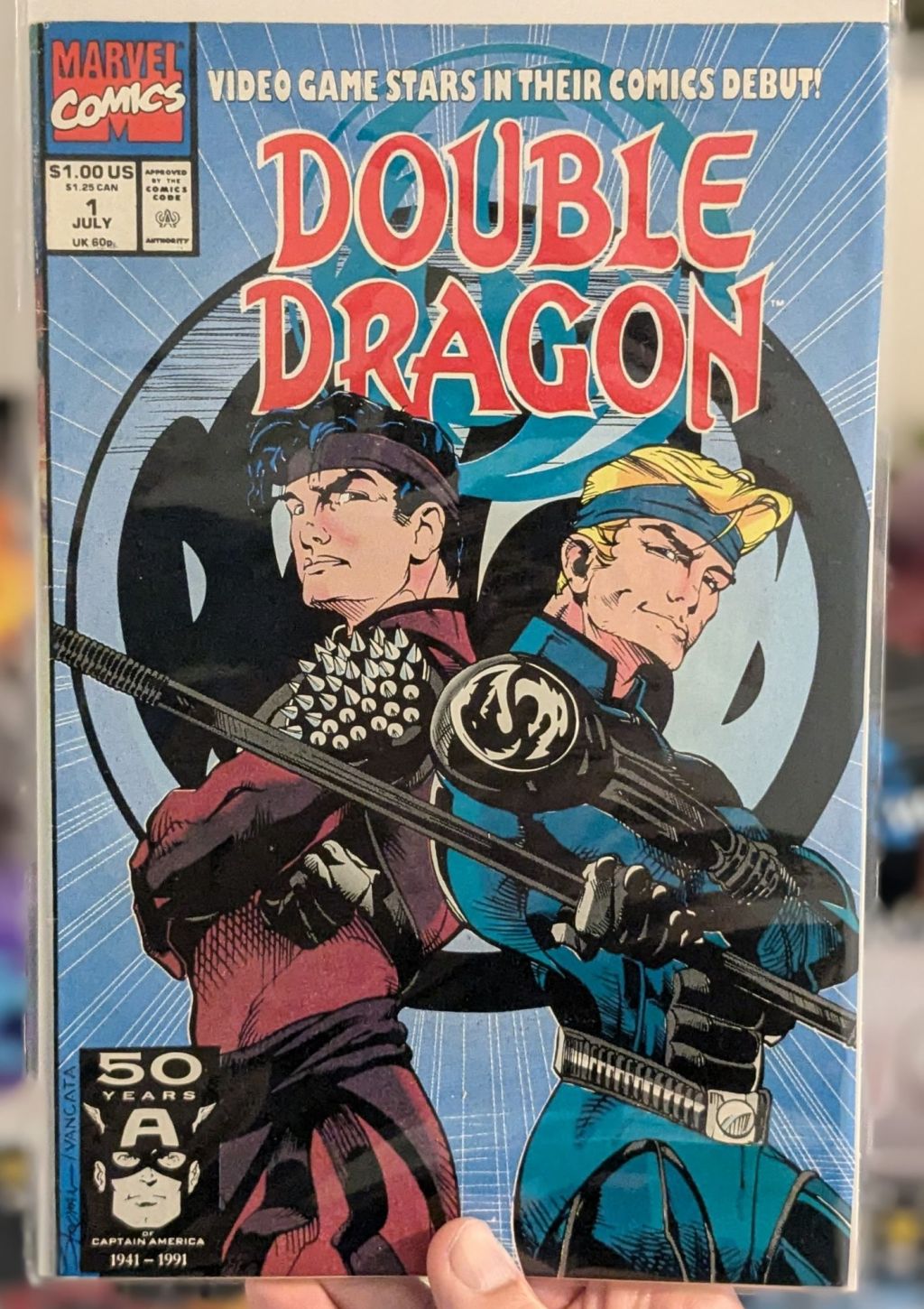

The first Double Dragon arcade game emerged in 1987, and kicked off a phenomenally successful period for scrolling beat ’em ups, with countless successors expanding on the elements and innovations that Double Dragon brought to the table.
It was an absolute masterpiece in its day, but for whatever reason its sequels could never quite hit the same heights as the original title. Still, it was a massively influential game, and its conversions to just about every console and computer platform meant that players could take on the bad guys as twin brothers Billy and Jimmy Lee at home, almost regardless of the hardware they had. Bizarrely, even the Atari 2600 got a port; despite not being very good, it joins a host of other arcade conversions on the 2600, such as Donkey Kong, that were admirable and impressive, given the limitations of the console.
In any case, this popularity led to Double Dragon growing beyond video games; few remember the obscure, cheap and downright bizarre 1994 movie, which had the T-1000 himself, Robert Patrick, as the end boss, rocking quite a unique look.
Even less people remember the cartoon series, which came a year before the live action movie and lasted for just one season. Similar to the movie, it added plenty of its own embellishments to what was a straightforward tale of vengeance and violence in the video games; super hero-esque transformations for our two heroes were added for some reason.
Perhaps the most obscure adaptation of the video game, however, is the Marvel Comics series from 1991. Lasting just six issues, it was published at a time when comics were just starting to embrace ultraviolent content, but Marvel, instead of aping the gritty, street level contemporary style of the video games, opted for something quite different.
The city of Oligopolis has fallen under the control of a mysterious supervillain named Nightfall, who has several powerful underlings, each with their own special powers. All that stands in the way of these evil bad guys are two bickering, martial artist brothers with access to their own superpowers, William and James (yes, Billy and Jimmy!) Lee, otherwise known as Double Dragon.
In this first issue, undercover police officer Marian Steele, an ally of the Lee brothers, has been kidnapped by Nightfall’s gang and placed inside a giant hourglass, in danger of the sand suffocating her if she’s not rescued in time. The Lees set out to find her and save her life, taking on different members of the gang, across numerous environments, as they do so.
With the utterly bonkers premise of this first issue, as well as sci-fi and superhero elements that feel really tacked on and unnecessary (given how much personality is injected into the memorable stage bosses of the video games; Abobo, anyone?), this is a bit of a weird comic.
The dialogue is, for no good reason, overwrought and melodramatic (the villain names are incredibly pretentious too), and the setting, seemingly in a cyberpunk-esque sci-fi metropolis, is something else that just feels unnecessary.
It’s cleverly structured like the video game, however, with the Lee brothers taking on underlings and then a stage boss, before moving on to the next one in a different environment, before ending up at a final location with Marian’s life in the balance.
The end of the first video game sees player one and two taking on each other for the ultimate victory, and that’s something that writer Dwayne McDuffie also makes sure to cover here; though again, it doesn’t feel particularly logical, even with the bickering that occurs throughout this issue. Marian has a bit more agency here than in the video game, however, and it’s good to see her being more than just a ‘prize’ for the boys to fight over.
It’s very much a product of its time; given that UDON Entertainment have recently released a Final Fight comic that sticks very closely to the source material, silly dialogue and all, it wouldn’t be unreasonable to expect that a more faithful Double Dragon comic is easily possible these days. And would have been back then, if publishers hadn’t been so squeamish about simply adapting the games; after all, this was an era where The Punisher was a massive deal in comics, and the gritty style would have been perfect for Double Dragon.
In any case, it’s an interesting curious at the very least; given that there’s only six issues, it’s not difficult or costly to acquire and read the entire run, either. So watch this space for further reviews of the weird, early 90s Marvel Double Dragon comic!
 MLGG: Pop Culture News, Reviews & Interviews
Leave a comment