
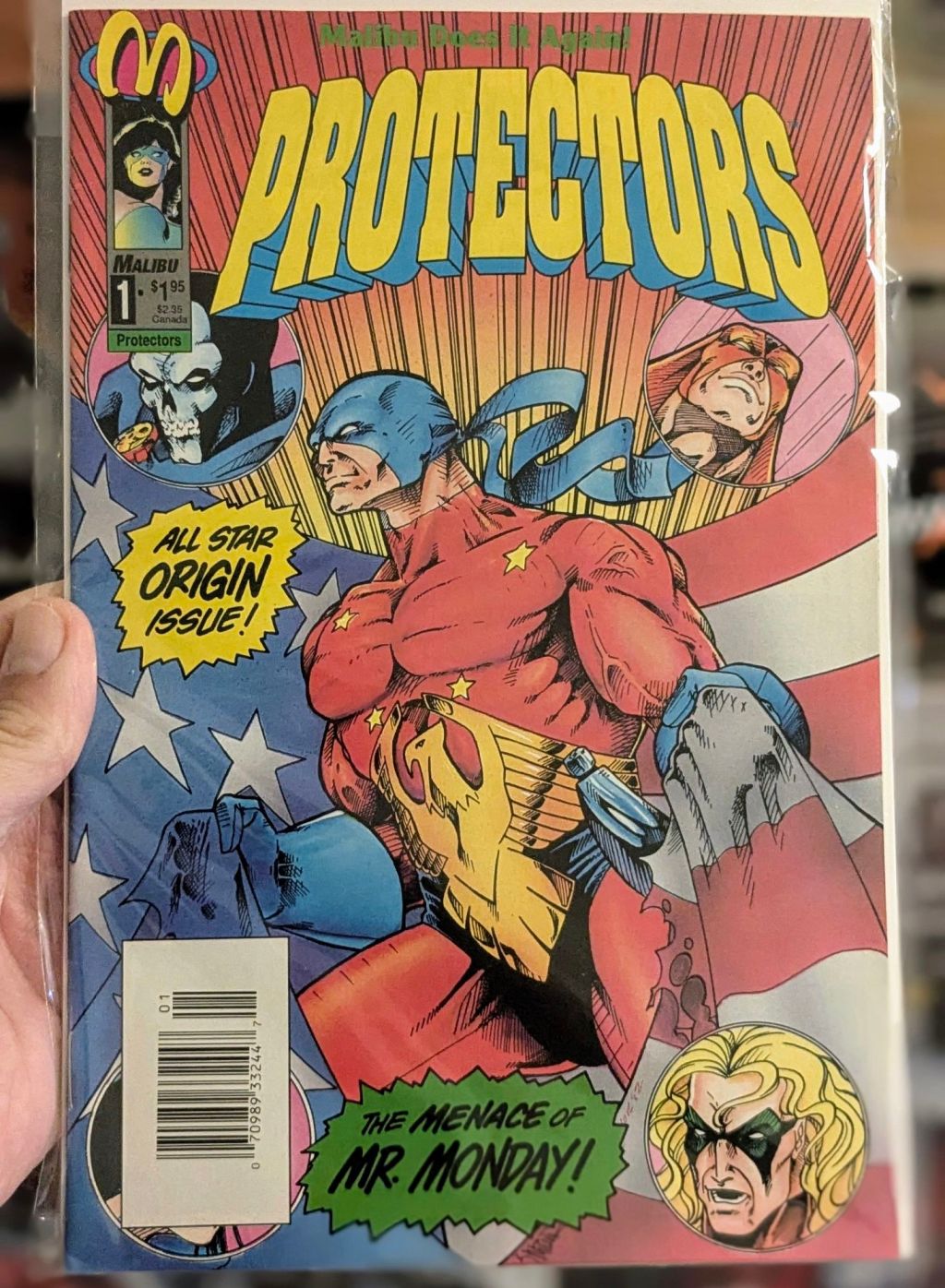
The early 90s was a thrilling time to be a comic book fan. Slowly and surely, the stranglehold that the Big Two (Marvel and DC) had on the minds of fans was slipping, allowing numerous upstart publishers to carve out their own, very lucrative, slices of the market. Dark Horse Comics had been successfully adapting R-rated movies into comic series for a few years at that stage, Marvel calling the bluff of a number of their superstar artists led to the creation and stratospheric rise of Image Comics, and even trading card publisher Topps had created their own comic line, with some fantastic licenses such as Mars Attacks and The X-Files. Valiant had their own superhero universe, and other publishers were also able to sustain themselves with a mixture of traditional superhero fare and edgier, more unusual stuff too.
Malibu Comics definitely fit the latter category, and their line of well produced, varied comics found quite a comfortable niche in the market. They had a hankering to get in on the shared universe action, however, and it seems to be that this idea first bore fruit in The Protectors.
Alan Moore and Dave Gibbons released Watchmen over 12 issues at DC, beginning in 1986, and it altered the course of superhero fiction forever. Even the big two’s usual superhero stories became darker, edgier and more violent; though quite often lacked the intelligence, insight and questioning of the very notion of costumed vigilantism that Watchmen brought to the table.
The Protectors launched its superhero team into a post-Watchmen world, and it shows. The team are formed after superheroes (known as ‘supranormals’) have been out of the public eye for five years, after a huge battle caused mass devastation on US soil. Gathered together by the government after a team of armoured terrorists starts attacking police stations and other government facilities, the team are brought together in secret, and act clandestinely at first. They are also forced to obey a ‘no-kill’ order, to help them regain public trust.
The heroes themselves are rebooted versions of Golden Age characters from the 30s and 40s; they’re somewhat awkwardly named (Amazing Man, Man of War and…The Ferret, to name just three), which has a certain charm, but doesn’t quite fit the gritty, more realistic tone that The Protectors aspires to.
The writing is a little clumsy at times too, with really thinly sketched characters, particularly when it comes to the team themselves. It is fairly in keeping with the style of writing found in comics in the early 90s, but it hasn’t aged well.
The art is particularly bad too, and feels incredibly rushed. The colouring is pretty good, however, especially by the standards of the era.
The Protectors doesn’t get off to the best start in this issue, then, but its premise of old school heroes having to adapt to the modern world and answer to the government certainly had potential, and that was enough for this to turn from a six issue, limited mini-series to one which ran for 20 issues, not counting various spin offs.
It was certainly intriguing enough for me to keep reading, but the spectre of ridiculous comic book gimmicks – which got so bad in the 90s (holograms, embossed covers, foil, trading cards, variant covers and much, much more) that it caused the market to crash – did hit The Protectors with one of the most infamously daft gimmicks of them all by the time its fifth issue came around.
Honestly though, it was that very gimmick (which I won’t spoil just yet), which caused me to check out this lesser known, all but forgotten series in the first place.
So I’ll be checking out more, and that gimmick will be making an appearance very soon. As they say, or said, in those days: watch this space!
 MLGG: Pop Culture News, Reviews & Interviews
Leave a comment