
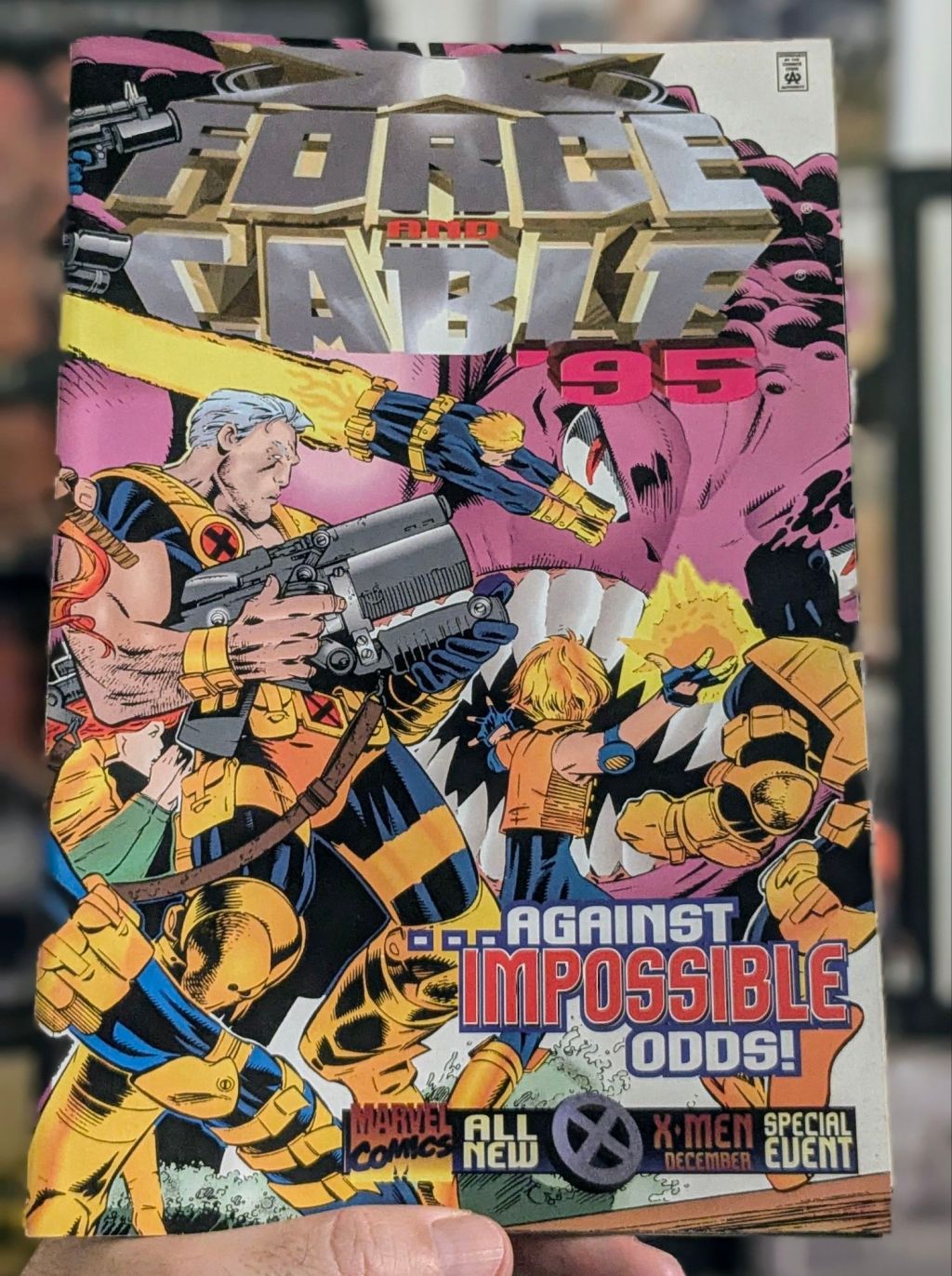
It’s easy to look back and laugh at the muscles layered upon muscles, the grimaces, the tiny feet (or lack of feet entirely) and the pouches (oh, so many pouches), but Rob Liefeld was once up there with the most popular comic book artists, and his X-Force featured all of his signature touches on a massive scale. The first issue of X-Force was polybagged with a trading card, and went on to sell a frankly astonishing 5 million copies.
Of course, multiple trading cards were available, so to get the set, fans would have had to buy multiple copies of X-Force #1; the comic book speculation boom was at a high at this stage in the 90s, with collectors and fans treating comics as an investment. The bubble burst a few years later, with ever more ridiculous gimmicks, overprinting and oversaturation of the market leading comics to drastically lose their pulling power and, more importantly, most of their value.
In any case, X-Force, like most Marvel titles and Marvel themselves, weathered the storm (though Marvel did, at one stage, file for Chapter 11 bankruptcy, which seems absurd given their place in mainstream pop culture now). It was one of Marvel’s ‘edgier’, more violent comics, with a team of practically militarised mutants led by the time displaced, techno-virus infected future soldier, Cable.
Knowing all of that context is quite important for the review of X-Force and Cable ’95 #1, because it offers a striking contrast to X-Force’s early image, in which it took itself very seriously.
Here, the comic is at its most light hearted and colourful, with Marvel’s acquisition of Malibu Comics and their industry leading, computer aided colouring techniques on full display. It’s a beautifully vibrant comic, in which the mutant team are on a much needed vacation, but end up being constantly harassed by the very silly, old school Marvel character, the Impossible Man. You see, Impossible Man has three slacker teen kids who he wants to find work for, and who better to approach than Cable, who has experience of leading a team of teens, and giving them purpose?
Cable’s rejection hits poor Impossible Man hard, however, and he continues to make a nuisance of himself, hanging around with his kids and pestering X-Force in an attempt to make them relent. Then a real threat shows up, giving him, and his kids, an opportunity to prove themselves.
It’s an absolute riot, and genuinely amusing. There’s some fantastic moments of slapstick humour, with Impossible Man appearing in all sorts of guises and getting into all kinds of scrapes.
I can only imagine how the readers of X-Force received this back in the day though; it really did take itself very seriously, and comic book fans who actually read the material, not just hoarded them for investment, tended to treat themselves seriously too.
As a concession to this, there’s also a backup story featuring Domino, the mutant whose power is mostly based on giving her incredible luck, which is closer to the tone and style of classic X-Force. It’s a bit of a disappointment and a drag after the extended, fun shenanigans of the main story though.
Still, this was a really enjoyable read all round, and proves that there’s still a lot of hidden gems from the much maligned, often style-over-substance, 90s era of comics. That, and comics from the time are generally very cheap these days (this one cost me the princely sum of 63p yesterday – shout out to the fantastic Southampton Comics!).
Oh, and (spoiler alert) there’s a big, beautifully designed monster in this issue which really impressed me too. So if you do manage to find this issue anywhere, pick it up; it’s well worth checking out.
 MLGG: Pop Culture News, Reviews & Interviews
Leave a comment