
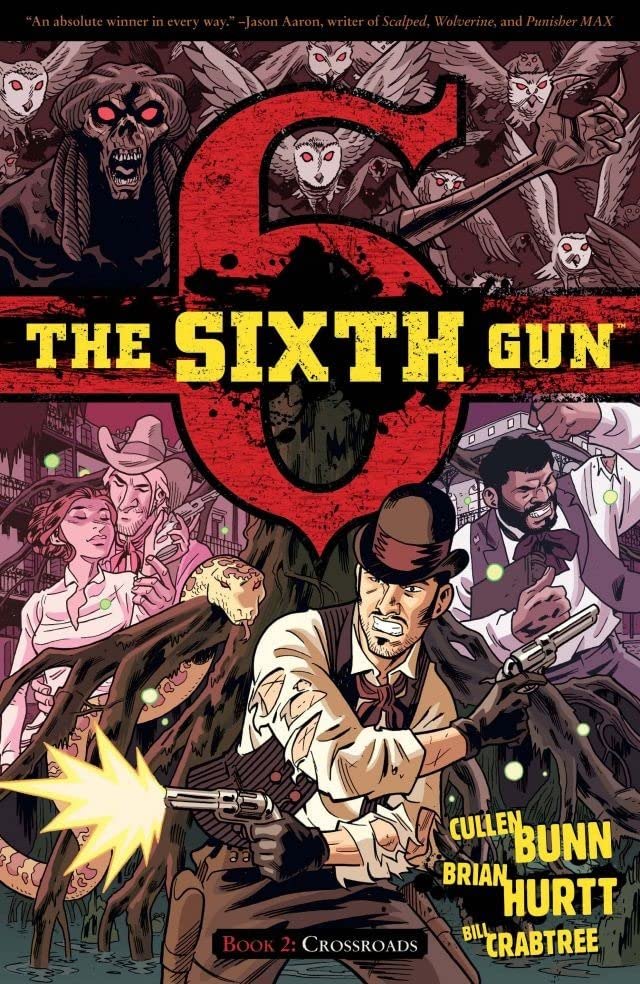

Perhaps it was my tabletop roaming of the Wild West this weekend that belatedly pushed me back into the supernatural, Weird West setting of The Sixth Gun. No matter the reason, it’s good to be back and following the excellent adventures of Becky Montcrief, Drake Sinclair and their associates as they attempt to keep a set of supernatural weapons out of the hands of some seriously evil villains.
Following the seeming demise of the vile General Hume at the end of volume one, Drake, Becky and the scholarly expert in dark magic, Gord Cantrell, are looking to find a way to safely rid themselves of the cursed weaponry, but there are some very dark forces looking to get in their way. Along the way, Becky also has an intimate encounter with Kirby Hale, who is definitely not the straightforward charmer he at first appears to be.
Though slower paced than the first volume, it’s no less compelling, with more world building and lore being revealed about the cursed weapons and a very supernatural climax.
Cullen Bunn’s skill with characterisation and presenting us with a compellingly detailed mythology is second to none; it can sometimes feel – in stories where layers of fantastical elements are gradually applied or revealed – as if new plot points, characters or items are a bit contrived and convenient (Deus ex machina even). It’s to Bunn’s credit that it doesn’t feel that way in The Sixth Gun.
Brian Hurtt’s art once again shows why his style is the perfect fit for the series too, with a cartoony, almost animated style that meshes the more realistic depictions of the Western setting with the more supernatural, sometimes horrific elements. Special mention also to Bill Crabtree for his excellent colouring; despite the art’s relative simplicity he ekes some great, bloody depictions of horrid creatures with some no-nonsense reds, amongst other things.
Despite its popularity upon release and wide availability even now, The Sixth Gun still feels as if it’s a bit of a secret amongst comic book readers. It’s not mentioned in the same breath as other high profile comics that have gone down in history as classics – and that’s a shame, because it outclasses (outguns?) so many of the big name titles you’ve likely heard about. It’s a comic that’s well worth reading and – due to its pseudo-period setting – ages a lot more gracefully than many comics set in either contemporary times or futuristic universes. Excellent stuff.

 MLGG: Pop Culture News, Reviews & Interviews
Leave a comment