
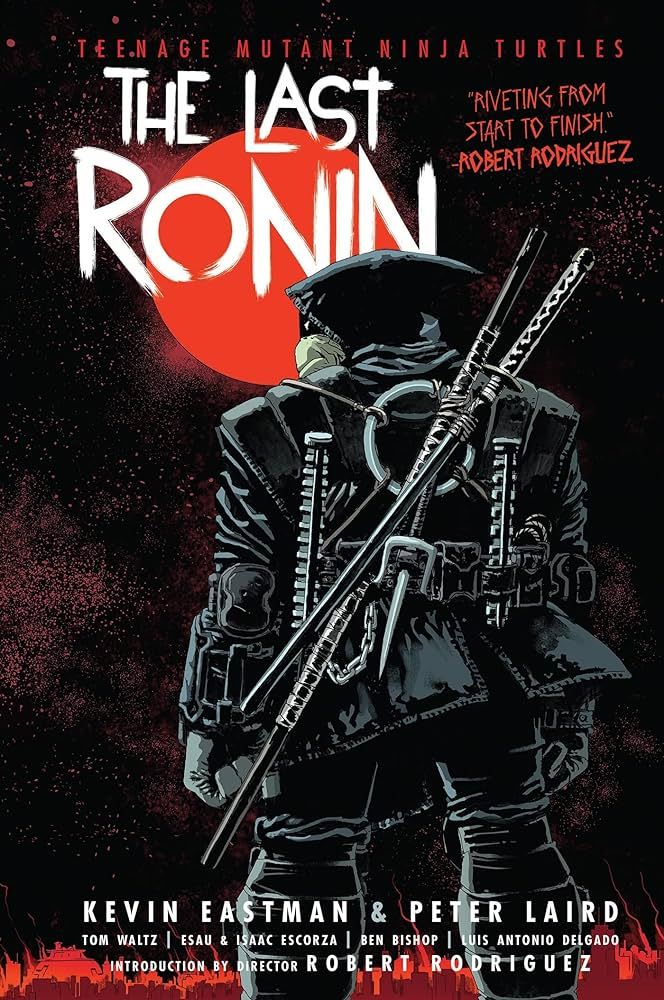

It’s the 40th anniversary of the Teenage Mutant Ninja Turtles, a series which was originally a parody of grimdark superhero comics and somehow, despite its humble, indie comix scene origins, became a genuine, multi-generational phenomenon that’s still going strong to this day.
Back in the mid 80s, thanks mostly to the influence of creators such as Frank Miller (whose style was the most obvious target of TMNT’s creators, Kevin Eastman and Peter Laird, in terms of its satire) and Alan Moore, comics were becoming ‘mature’, more serious and much more violent. Miller’s Daredevil led the way for the mainstream, and the first issue of the original TMNT even tied in the source of their mutation with the exact same event that served as Daredevil’s origin.
So it feels appropriate that, decades later, the Turtles get their own shot at the type of bleak future story popularised by Miller in what was once considered near the very top of superhero stories, Batman: The Dark Knight Returns.
Just like The Dark Knight Returns, The Last Ronin is set outside of continuity, presenting a possible future for our heroes.
Or at least, one of them; in this dark tale, only one of the Turtles is still alive, with the clan war between the heroes and the Foot Clan having boiled over fatally for the majority of the good guys. The line, surviving Turtle seeks to take revenge on the Foot Clan, who are in control of New York, keeping it’s populace oppressed and ruling, as you’d expect, with an iron fist (or foot, perhaps).
Shredder’s grandson is the pseudo-dictator in charge of the cyberpunk-esque city, with flying cars and cybernetic ninjas a familiar sight in the streets.
To say much more, detail-wise, about the plot would be a bit too spoilery; in fact, even the identity of which Turtle is now on his quest for revenge is one that’s best left revealed by the narrative.
It’s an incredibly compelling story, told deftly with stunning art (by Esau & Isaac Escorza, Ben Bishop and, drawing in the original indie comics art style for flashbacks, creator Kevin Eastman himself, with beautifully nostalgic black and white artwork) and a great script.
It’s a very involving tale that unfolds in a clever way, with superb action and truly affecting, often heartbreaking, scenes that fill in the blanks that led us to the current status quo.
Though it does demonstrate, once more, that TMNT has often become the very thing that it initially sought to make fun of, it’s really hard to complain when the end result is this good.
As a kid, most readers of the original TMNT comics didn’t even notice the parodic elements of the stories, and instead it just felt to us, like it was another edgy tale, albeit one with unusual and unique heroes. The IDW run, and several before it, as well as The Last Ronin, sort of feel like a validation of that viewpoint; there’s plenty of room for TMNT to be kid friendly, or satirical, or dark and edgy; it’s a very pliable concept, and it often works well with just about any approach it takes.
If you’re already a fan of TMNT, you should definitely read this five issue mini series; especially as its popularity and critical reception has enabled it to kick off its own corner of TMNT continuity (the ‘Roninverse’).
So not only is it a fantastic, self contained story in its own right, but it’s the launching pad for many more stories, including a direct sequel that’s just begun.
As much as I’m glad that this does feel like a complete saga all on its own, with a very eventful five issue run, I’m also happy that this specific universe is expanding, and I can’t wait to see where it goes next.
You can buy TMNT: The Last Ronin from Amazon here.


 MLGG: Pop Culture News, Reviews & Interviews
Leave a comment