

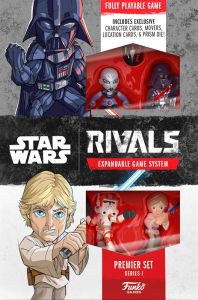
Billed as an ‘Expandable Game System’, Star Wars Rivals is essentially a very basic CCG with some admittedly nice miniatures, although their oddly proportioned style won’t be to everyone’s taste.
In Star Wars Rivals, players have up to three characters on their side, though this Premier Set only has two per side, plus a generic cardboard token (with no image whatsoever, just text) to represent a non-unique trooper character, for each player.
Each player has their own deck of cards to draw from; these are composed of cards that each character in the set can make use of, generic cardboard trooper included.
Each turn, three locations are up for grabs, each with their own points values and, sometimes, special abilities.
Each player places their characters at a chosen location, one at a time, starting with the player who has the ‘High Ground’ token, which is essentially Initiative with an amusingly thematic name.
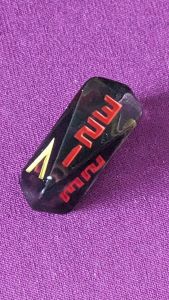
The oddly shaped die is then rolled and this determines which locations are scored this turn.
As this happens after characters are placed, it can sometimes mean that a hotly contested location isn’t even up for grabs on that particular turn.
Each player can then play a card from their hand face down; once both have done so, the player with the High Ground reveals theirs and carries out their action, then the other player does the same.
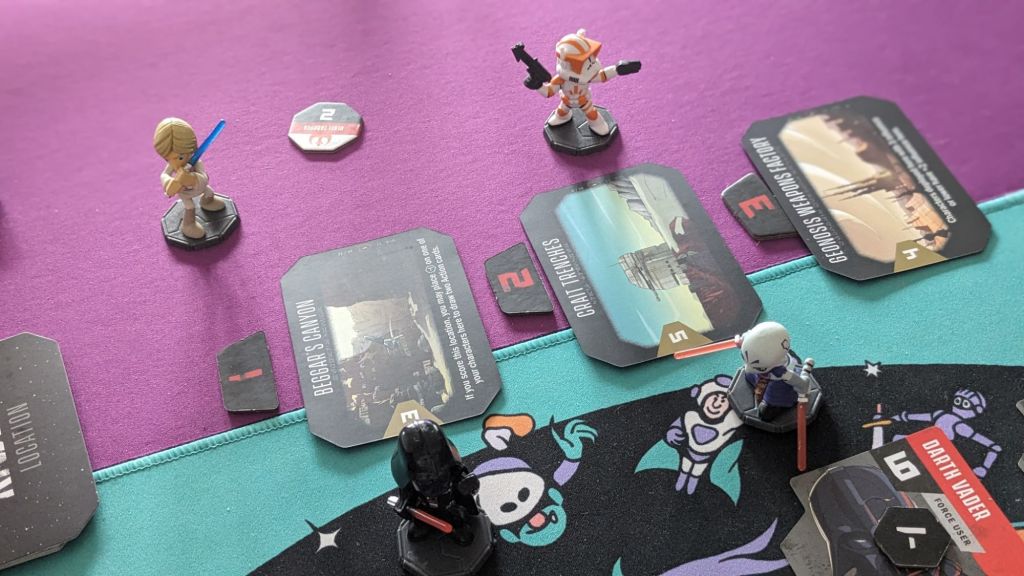
Each character has an Influence value on their card, though they can lose Influence through location and player card abilities; the player who has the highest Influence at a contested location wins the card and adds it to their score pile.
Once scoring is done, each player takes their characters back and the High Ground passes to the next player.
When deploying, instead of moving a character to a location they can instead be moved to the side of the play area, where they’re considered to be in the Bacta Tank; all of their -1 Influence tokens are removed at the end of the turn and the player gets them back for deploying next turn.
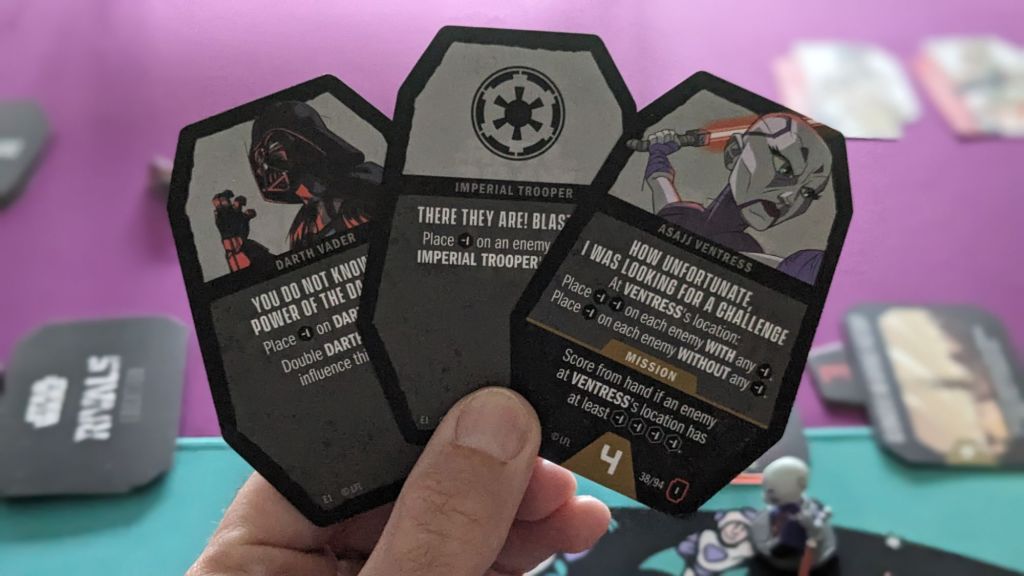
Some action cards have missions which can add bonus points, and these can really turn the tide of a game; this is one of the most interesting mechanics in Star Wars Rivals.
It’s a game that does have very light strategy, but with the randomness of the die roll, it adds an element of luck that does feel out of the player’s hands, and this can be really frustrating.
Adding to this luck element is the fact that, if you want to have a full squad and not rely on having a generic, boring token as one of the characters you use, you’ll need to buy a booster pack.
Booster packs are sold in Light Side and Dark Side variations; this is a great idea in theory as you can be certain of getting a character for a particular side.
The problem is, with just one character in a booster, and such a small selection of characters overall, you may well end up with duplicates if you buy more than one.
Given the cost of a booster pack, which isn’t exactly cheap, this does feel somewhat unfair.
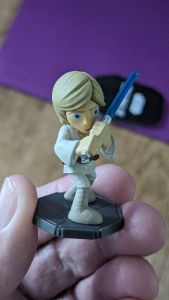
It’s also not that great a game that players will be particularly interested in expanding their selection of characters, beyond getting an extra one per side just to have them (unless they’re really taken with them and want to collect the entire set, but they’re definitely not that nice).
Star Wars Rivals does seem to have been quietly released and sent out to just wither away, but given its thin gameplay and somewhat cynical design elements that push you into immediately requiring booster packs, perhaps that’s not surprising.
It’s a reasonable game for very young or very inexperienced Star Wars fans, when it comes to tabletop games, but it’s not one I’d recommend particularly highly to anyone else.
You can buy the Star Wars Rivals Premier Set from Amazon here.


Leave a comment