


The original Evercade console was announced to a reception bordering on bewilderment from many retro gamers, with such a wide prevalence and low cost of handheld emulation devices, which can provide a platform for using thousands of classic game ROMs. If gamers already had such easy access to just about any game title they wanted, on any platform, why would they want one which featured limited collections of games, at a relatively high cost too?
The creators of the Evercade, Blaze Entertainment, had several aces up their sleeve, however. Anyone who’s actually ended up with a retro handheld and filled its memory card with ROMs knows that it offers the illusion of choice; you’ll often pick a game, and then discard it within seconds if it doesn’t grab you, moving onto something else in the meantime. It’s rare that you’ll actually sit and play anything at length, when you have everything waiting for you.
Narrowing a collection of games down to a curated selection, with the benefits of save states, has meant that I’ve given lots of old games a longer chance and much more attention than I probably ever would have otherwise, except back when they were originally released.

Having a numbered collection of cartridges was another masterstroke from Blaze, given how many retro gamers love to build up various collections.
Finally, and this is perhaps the most important, while many retro gamers don’t really consider the ethical implications of downloading and using ROMs, especially as most of the games they install and play have been abandoned and can no longer be played any other way, they do want to be able to actually play these games; sometimes a game doesn’t work as intended, or at all, and emulators can be a bit fiddly for the average Joe to get working.
In short, the Evercade has proven a success because it works, it provides a physical collection that’s really satisfying to slowly build up, and also because Blaze have done a great job of covering all bases with their collections, including bringing ‘new retro’ (that is, modern games designed and produced for old school hardware) titles to the console.
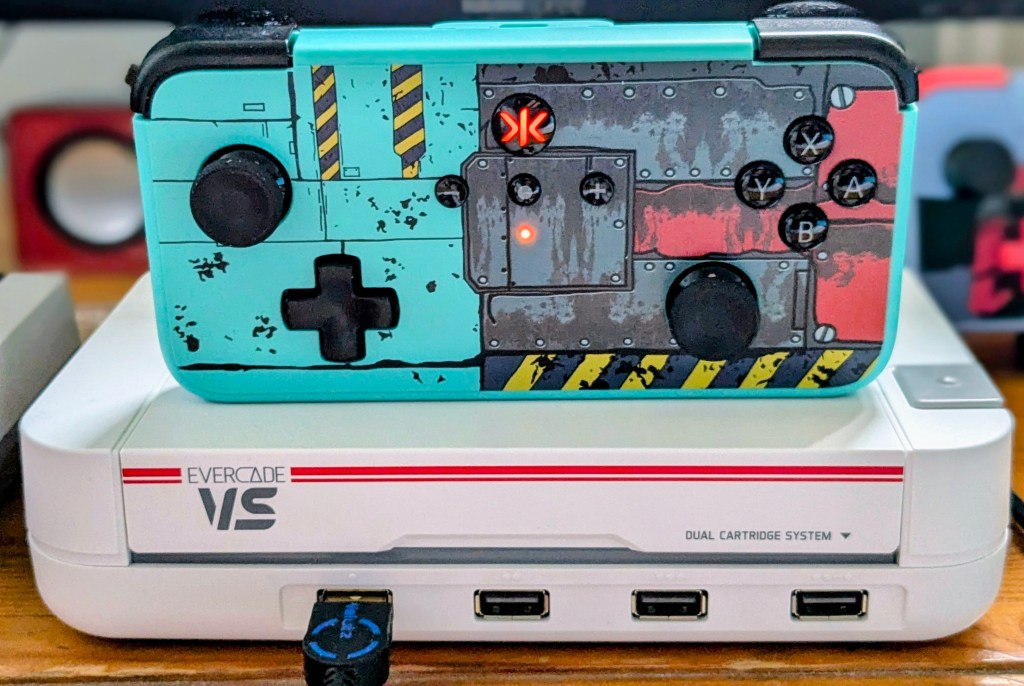
Though the first Evercade worked well enough, it was soon joined by a full, home console little brother: the Evercade VS (shown above with a CRKD Neo S controller). Allowing for up to four players to play simultaneously, it offered a way around the biggest limitation of the original device (no multiplayer), as well as great new features to make it worthwhile having as another device to play Evercade games on.
This was followed by the Evercade EXP; so far the definitive way to play Evercade games on a handheld, with a much better screen and lots of new features that included a TATE mode, for playing arcade titles in their original, vertical orientation. It was clear that Blaze knew exactly what their audience needed, and the Evercade ecosystem was, and still is, providing both great hardware and software to entice retro gamers to pay for, and play, old games in a legal and ethical way.
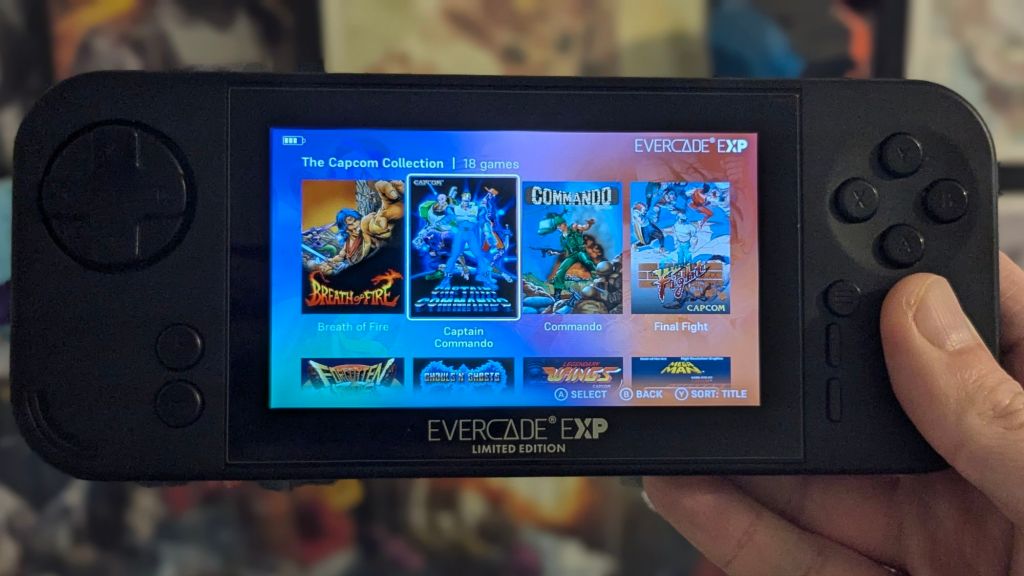
There was one slightly controversial element of the Evercade EXP that needs to be addressed, however (at least, it proved a minor point of contention for Evercade collectors). The console was pre-loaded with a selection of Capcom games, which couldn’t be obtained in cartridge form. Ostensibly a way for Blaze to bring these games to Evercade players even though they couldn’t get a licence for physical Capcom collections, Evercade gamers weren’t universally pleased with having games they couldn’t use across their different devices, even if it was great to have some timelessly brilliant Capcom games on the system.
The problem Blaze had (and has) was that not every publisher or rights holder would allow all of their games to be licensed for the physical cartridges. They hit upon an odd solution for this problem, however; though initially baffling, as was the case with the original Evercade, it’s made more sense once players have actually been able to get their hands on the final hardware.
Shorn of the Evercade branding (somewhat bizarrely), the Hyper Mega Tech! Super Pocket consoles have been fantastic, even lower cost entry points to the Evercade ecosystem than other hardware (also very reasonably priced) has been.

The first to launch, in 2023, were Capcom and Taito editions, each in a unique colour, and being designed in a more Game Boy-esque vertical orientation than the wider Evercade and its EXP successor. They definitely look more toy-like than the Evercade consoles, and they’re lighter, with a lower quality of display too.
Yet, arguably, the types of games you’ll be playing on Super Pocket consoles don’t need any fancy, higher definition displays, given the original screens they would have been played on.
That reduction in quality, which results in a big reduction in cost, is another Blaze gamble that’s paid off, because these consoles are lovely little ways to experience even more classic titles. Though it was bizarre that the Capcom Super Pocket contained most of the titles already pre-installed on an Evercade EXP, if you were just interested in getting your hands on a bunch of classic Capcom games, the Super Pocket was a cheaper way to do so.
The Taito collection was essential, even for current Evercade owners, featuring classics such as several Space Invaders games, Bubble Bobble and plenty more besides.
Here’s the weird part, and yet another masterstroke: despite the lack of branding, these are Evercade compatible consoles. All Evercade cartridges will work on them, so you get a curated collection of games on a colourful device, as well as access to the wider Evercade ecosystem.

The Technos Edition Super Pocket is the latest to be released. Is it any good?
In bold, bright blue and white styling, I have to say that the Technos Super Pocket is probably the least attractive of the line so far, in terms of its colour scheme. That’s subjective, admittedly, but it doesn’t look as good as the other consoles in my opinion; though it’s worth noting that, as you can see above, I own the translucent limited editions of the previous two consoles.
No limited colour variant of the Technos console was released, which feels like a missed opportunity; the Atari Edition Super Pocket, released concurrently with the Technos console, did get a lovely, faux woodgrain edition, making the Technos Edition feel like it’s not been given the same care and attention as the others.
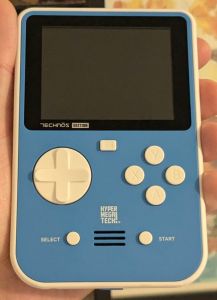
Looks aside, the Super Pocket itself performs well; though it feels very light and, it must be said, a little plasticky, the buttons and dpad function well for the included games, though the rear buttons (used for more advanced games in the Evercade’s range) are often accidentally pressed, due to their positioning.
It does mean that the Super Pocket is probably best used to play older titles that don’t use those buttons, but it’s still an unfortunate issue. The rear buttons feel a bit less spongy than the dpad and the face buttons, but honestly, for the included collection of games they’re all fine.

The display itself is the same as you’ll find on other Super Pocket consoles; though it’s a step down in quality, in terms of resolution, from the Evercade EXP, it’s more than fine for its intended use, and for the games included. It’s definitely bright and clear enough, and the console allows for visual options such as two different strengths of scanline filter, to ape the look of old school CRT screens too.
Sound is adequate; there’s still an odd issue where the lowest volume level isn’t quite low enough before it goes to mute, but that’s honestly a pretty minor issue. The console has a headphone jack, so you can still hear your games when you’re out and about, or need to close yourself off from the world a bit, even at home, and this works nicely. I do have to mention the menu music, which is the same across all Super Pocket devices; the tune is an absolute banger, for no reason at all. It’s great!
The console is charged via USB C port, and lasts for over 4 hours on a single charge. Though that doesn’t sound all that good, it’s surprising how long the battery lasts when you’re just grabbing the console for a quick bash on a game or two here and there.
So, how about the games themselves? Well, being a Technos collection, it’s very heavy on the Double Dragon series and scrolling beat ’em up games in general. If that’s your bag, you’ll be pleased with what’s on offer here, even if most of the Double Dragon games have aged less gracefully than, say, Capcom’s beat ’em up titles.

There’s a nice variety of systems they’re drawn from too; arcade, 8-bit, 16-bit and even Game Boy games are here, and it’s awesome to revisit, or even discover, the various games as they appeared on different systems.
The first Double Dragon is here in its original arcade form, along with its NES and Game Boy versions (the latter proving to be surprisingly good). Double Dragon II: The Revenge’s arcade version is here; it retains the directional attack buttons of the original, and I have always found this to be less intuitive and enjoyable than the first game.
The batshit crazy, globetrotting weirdness of Double Dragon 3: The Rosetta Stone is also here in arcade form; notable for featuring a sort of micro transaction style shop, the capitalist edge is shorn from it when it’s here in unlimited credit form, but it’s still far from a great game. Enjoyable enough, though.
SNES title Super Double Dragon is another disappointing game in the series, which shows that the Double Dragon titles, despite the first game’s influence and innovations, really weren’t keeping pace with their contemporaries.
The groundbreaking Renegade, which really laid the groundwork for Double Dragon and other arcade beat ’em ups, shows its age, but is a good look at how far the genre came in such a short time. The Combatribes is a chunky, hilariously daft scrolling beat ’em up that remains a pretty underrated game.
Lastly for beat ’em up fans is the absolutely glorious, non-linear action of River City Ransom, which introduces light RPG elements and is streets ahead of just about any other game, beat ’em up or otherwise, on this collection. That’s despite its unassuming, 8-bit visuals; if you get hold of a Technos Super Pocket, it’ll likely be this game that holds your attention the most!
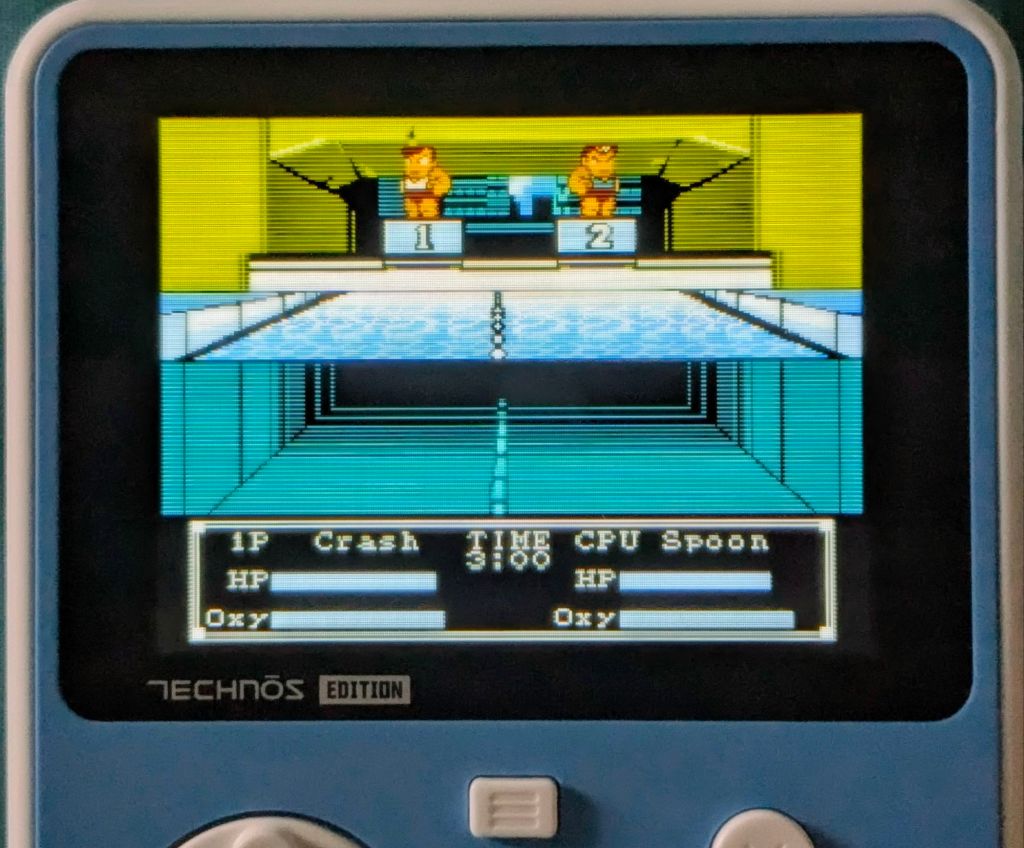
Super Dodge Ball and Super Spike V’Ball are sports titles that I found personally uninteresting, but if they’re your type of game, they’re reasonably well done. Crash ‘N’ The Boys: Street Challenge offers a variety of sports themed mini games, in the ‘Kunio-Kun’ style also seen in Renegade, River City Ransom and Super Dodge Ball.
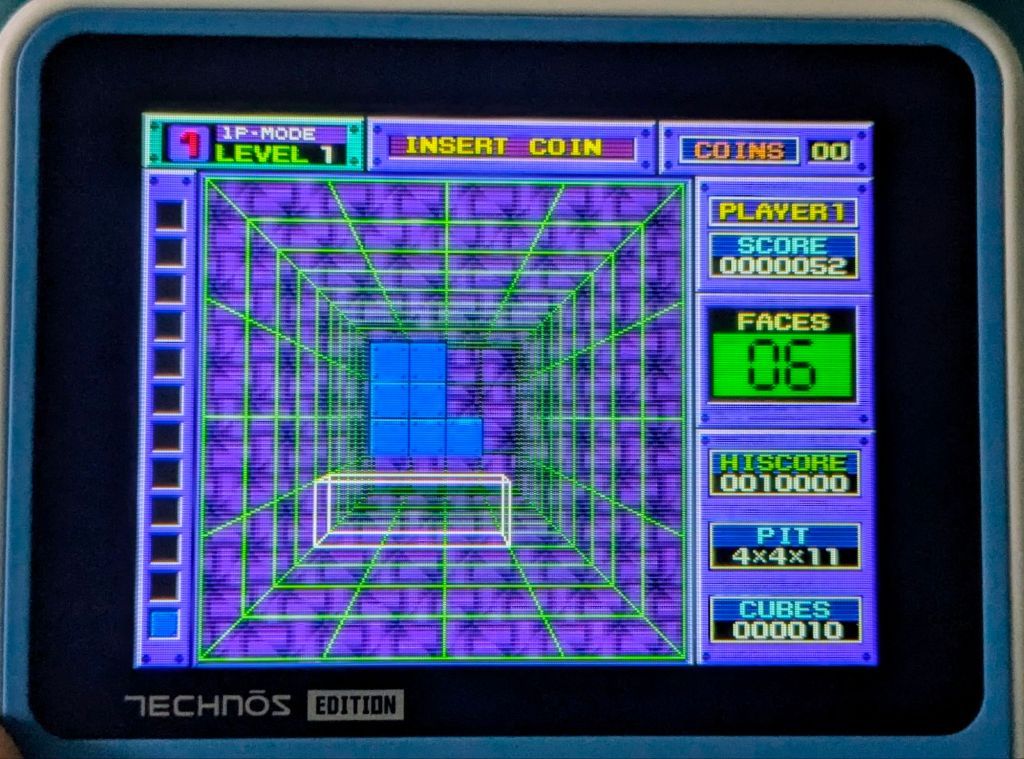
Arcade puzzler Block Out is a mind melting, 3D take on Tetris that has blocks dropping down a pit; it’s really difficult to get your head around its block turning mechanics at first, but incredibly satisfying once you get to grips with it.

Finally, there’s the very old school Minky Monkey and Mysterious Stones: Dr John’s Adventure; both offer addictive, simple arcade fun. They are both vertically aligned games, however, so they’re pretty small on the Super Pocket’s screen.
Overall, the Technos Edition Super Pocket is a great little console, and a nice way to enter the Evercade ecosystem (and enjoy its eclectic extensive ranges of cartridges), if you’re not a part of it already. Most games featured can be found on either the Technos Collection 1 cartridge and the Technos Arcade 1 collection, but both are now Legacy Cartridges, meaning that they are no longer in production. This, in turn, means that they’re often found at massively inflated prices on the secondary market, so if you want to get hold of the Technos titles legally, this Super Pocket is likely to be the cheapest option. It’s also well worth noting that arcade Double Dragon was not on either Technos cartridge, and is by far the best version of the game, so again, that’s another point to the Super Pocket.
If you aren’t particularly fussed about the Technos games but want to grab a Super Pocket, for me the Capcom Edition is the best one, with Taito a close second. Of course, we also have the Atari Edition waiting in the wings, and that provides a huge selection of games which, though admittedly very dated, might be the perfect collection of pick up and play games. I’ll soon be checking it out, but for now I’d say it’s a great time to be a retro game fan, with so many ways to legally play a variety of old school titles; the Super Pocket really are lovely little devices which, while not perfect, do the job just fine.
There’s also no fuss when it comes to the games actually working, and no need to search potentially dodgy websites for illicit and, at the very least, morally dubious game ROMs.
Priced at £49.99 RRP, you can buy the Technos Edition Super Pocket from Amazon here.
 MLGG: Pop Culture News, Reviews & Interviews
Leave a comment